
A narrative guide to journalistic survival in the age of artificial intelligence and social media influencers

Canadian broadcast journalist Molly Thomas is a seasoned journalist with over 15 years of experience developing and hosting live news programs focused on politics, technology, and humanitarian issues. Early on in her career, Thomas realized the power technology has to reshape industry expectations for journalists. When she started in journalism, she recalls audiences consuming news primarily through mainstream news outlets, where a team of editors, publishers, and fact-checkers reviewed newspaper articles and broadcast scripts before reporting to the public. However, as artificial intelligence (AI) and social media gained traction, Thomas noticed the pressure put on journalists to publish reliable information faster.
Over time, Thomas and her colleagues’ discussions extended to concerns around the production of credible news to keep pace with text generated by AI and the speed at which social media personalities were spreading sensationalized news stories. “I think both as journalists and the public, everybody is struggling to figure out how to navigate this new space,” says Thomas. “The industry has drastically changed, and the biggest shift is the media landscape because traditional media are no longer the gatekeepers of information.”
After working at a number of daily broadcast outlets, Thomas applied all the insights she had gleaned to a new project she helped get off the ground. If this was what journalism was up against, she decided to address it head-on. She became one of the forces behind a new show focused on debunking misinformation, disinformation, hoaxes, and conspiracies within the current media landscape.
Since October 2024, she has hosted the series Big: If True, which airs on TVO, Ontario’s publicly funded educational television broadcaster. The weekly TV program looks at misinformation found across the internet. The goal is to help audiences pinpoint inaccurate or manipulated information. Whether it’s deciphering misleading headlines, dissecting the power of news influencers on public opinion, or unpacking the analytical and emotional impacts of AI, Thomas and her team dig deep into these content drivers to help people identify, contextualize, and combat the spread of fake news. “There’s always been disinformation…but what has changed is the technology in front of us and how fast information can move,” says Thomas. “There is still good information out there, but you have to know how to find it. You need to know what things are trying to trip you up.”
At a time when people can easily absorb information from Google’s new AI summaries or scrolling through social media feeds, some journalists are undertaking more education and training to work alongside these digital forces without compromising journalistic standards in the process. “We want people equipped with tools so that they’re able to say, ‘Okay, whatever this information environment throws at me, I can take it on.’ We want empowered people, not people giving up on believing in anything,” says Thomas.
At the 2025 JournalismAI Festival, a two-day conference in London, England, designed to foster educational conversations around the newsroom’s digital transformations, one of the panelists, Athandiwe Saba, pointed to three waves of digital disruption to traditional media over the years. The award-winning investigative data journalist and AI strategist discussed how the invention of the internet, social media networks and, most recently, AI have rewired audience consumption of news content and the verification of truth through their tendency to privilege speed and convenience over checks and balances.
“You see a lot of rage-baiting, you see a lot of fake news. You see a lot of angry posts that will incite people’s emotions…so it’s tough for us in the industry who are trying to be fair, balanced, nuanced, and contextual. It is much harder to get out that information and for it to stick with people,” says Thomas. In today’s media landscape, AI and influencer reporters are blending news, politics, and entertainment to garner large audiences through short and simple explanations of complex topics. That has left journalists grappling with how to integrate these digital tools into their work without compromising their journalistic integrity.
According to the Multidisciplinary Digital Publishing Institute (MDPI), AI is intended to free up time for journalists to conduct more in-depth reporting, devote more time to the writing process, and deliver more relevant and timely news content to reach a wider audience. The MDPI also noted that between the mid-2000s and the 2010s, a subset of AI known as machine learning became a useful technology in several industries, including journalism, for its ability to efficiently identify patterns in large datasets. A 2019 report from the Canada Media Fund noted early uses of AI involved assisting with the publication of news articles that required plugging in routine statistics such as sports scores and financial reports. However, when American AI company OpenAI launched its generative AI tool, ChatGPT, which is trained on large language models (LLMs) to pump out data based on human prompts, this innovative technology opened the door to new experimentation. Today, journalists use AI’s capabilities to summarize documents and data, compared with AI’s early uses of gathering information, editing drafts, and transcribing interviews.
“We’re seeing new rules emerge in newsrooms that didn’t exist before, to try to optimize content so that it’s discovered by AI,” says Jessica Johnson, a journalism educator at the University of Toronto and a research fellow at the Centre for Media, Technology and Democracy at McGill University. After working a little over five years as the editor in chief of Canadian magazine The Walrus, she decided to pivot her career toward education, media policy, and the business side of journalism. “I was more and more preoccupied with the state of media in the industry while I was working [at the Walrus], because a lot of my job as an editor was talking to people about the value of journalism, the mission of journalism, and the financial state of the industry,” says Johnson. At the University of Toronto, she taught a course called The Future of Journalism, which aimed to prepare future reporters for a work environment in which technology and online platforms are challenging the traditional functions and ethics of journalism. According to the MDPI, AI’s growing presence in the media landscape has raised questions among media scholars about the quality of information produced by AI based on its training on historical data, which might contain one-sided perspectives that exclude diverse voices and perspectives.
Researchers Samson Olufemi Olanipekun and Oluwasegun Olakoyenikan pinpointed how AI systems offer “little insight into how they generate or prioritize content,” in the World Journal of Advanced Research and Review. As a result, these systems can create “algorithmic bias,” which manipulates, exaggerates, and even hallucinates facts, context, and one-sided narratives to align with an article’s angle. Johnson notes how AI-generated errors can damage audience trust in news outlets, since audiences rely on the reporters to provide credible information. While the mistakes may originate from AI technology, she emphasizes how accountability still falls on humans and institutions implementing these digital tools in their work.
Others, like Craig Silverman, a Canadian tech journalist and media educator in online verification, also share these concerns. Silverman points out how innovations like AI can create an “illusion of convenience, expertise, and authority,” by providing journalists and audiences with exact answers to their questions without accounting for context, intent, and credibility. “That’s the reality for a lot of new technologies in that it has undeniable benefits, but sometimes the conveniences, the benefits, and the disruption that it brings comes with downsides, unintended consequences, and negative effects,” says Silverman.
The reliance on digital tools and technology for news content stems from a variety of factors limiting audience access to credible, fact-checked online sources. In Canada, amid the decline of printed news content, publications began the shift toward online news access through paid subscriptions after attempts to sustain funding through digital advertising failed. Of course, as the Center for Media Engagement at the University of Texas notes, hiding news stories behind a paywall helps a newsroom’s financial stability, but it also hinders access to verifiable news content.
More than a decade ago, in 2014, Silverman conducted a study examining how online news sites covered unverified claims circulating through social media and poorly sourced reports. Silverman observed a “holy trinity” behind the constant flood of online misinformation: widespread internet access, the rise of social media, and the use of smartphones. News consumers could now spread viral content across various digital platforms, often before the information even reached the press.
When these emerging online stories do catch the attention of news sites, they are often amplified in an attempt to gain more audience engagement, but without concrete context and facts to back up the story’s claims. The report noted, “News websites dedicate far more time and resources to propagating questionable and often false claims than they do working to verify and/or debunk viral content and online rumors.” As a result, these unverified claims gain credibility through the press and continue to be referenced or repeated across other news websites, and appear true to readers.
Silverman’s report also mentioned that few journalists and news outlets debunk viral content and online rumours in emerging news coverage. In Canada, the scarcity of fake news debunking from journalists and news organizations stems from the lack of investment in dedicated disinformation reporting. This journalistic beat aims to address falsehoods in news stories, but also trains journalists to report on unverified information without amplifying it.
As the host of a show focused on debunking falsehoods, rumours, and conspiracies in the news, Thomas also points to the challenge of engaging audiences with this type of simple, straightforward news content. “I think a lot of our show, as we grow it, as we keep putting out content, is like, when do people come back to their vegetables? When they don’t feel good. When something’s gone wrong in their body because they haven’t been paying attention,” says Thomas. “I think a lot of our show will help a lot of people, because unfortunately, they don’t take their vegetables for a long time, and then at some point it kicks back at them, right? It’s gonna take some people to be in a position where they’re helpless to turn and say, ‘Oh, wait a second, I need some more help around this, I need to pay more attention to this.’”
“AI should not be a shortcut. AI should be a way for people to be able to find smarter, better ways to work and without losing their critical thinking.”
Without an increase in disinformation reporting, the few journalists and news organizations that debunk claims may struggle to gain the same audience reach as those spreading viral misinformation. This issue has only intensified in Canada, where the social media giant Meta banned media outlets from publishing news content on social platforms such as Instagram and Facebook in the wake of 2023’s Online News Act (Bill C-18). This has restricted access to news outlets and has prompted Canadian audiences to seek updates through news-adjacent platforms or influencers.
While this alternative news ecosystem has the potential to offer fresh perspectives often unseen or overlooked in traditional news outlets, it can also make it easy for news consumers to access bad-faith content online. A Reuters Institute study on the growing trend of news influencers found that the news platforms and personalities who operate under “pro-free speech and anti-mainstream media narratives” dominate the social media space. These narratives tend to be rooted in radical viewpoints and contain hate speech framed as benign online chatter opposing the perceived censorship of views excluded from mainstream media. Researchers from the Institute for Strategic Dialogue published a 2020 study uncovering more than 6,600 online channels across major social media sites such as Facebook, YouTube, and X, involving Canadians spreading extremist views on racial and gender-based issues. These findings likely stem from Meta’s cutbacks on content moderation and fact-checking resources, allowing for influencers and content creators to spread their opinions as if they were facts, without evidence to back up their claims. Hence, more left-leaning news influencers have moved to social media platforms such as Threads and Bluesky, but audience reach on news-related topics remains minimal. This digital divide can make news consumers more vulnerable to misinformation and manipulation, highlighting the need for well-informed, fact-focused voices to be present across all online platforms.
The same report from the Reuters Institute on the recent trend of news influencers found that the majority of them operate independently, which includes editing and fact-checking their own content. The level of investigation and newsgathering also varies depending on the platform, as the report identified four types of news influencers: commentary, news and investigation, explanatory, and specialism. The report also found that the most popular news influencers are the ones providing commentary on current affairs, where the investment in newsgathering tends to be low. The limited content oversight, fact-checking, and research on these platforms can blur the lines between informed news commentary and unverified opinions, which can cause audiences to struggle to separate facts from sensationalized content. The report also pointed to news influencers as playing a critical role in shaping public opinion, as social media’s various algorithms steer audiences toward news content that aligns with their own views. This algorithmic bias emphasizes the need for news influencers to evaluate the level of accuracy and transparency in their reporting to build credibility and trust with their audience.
An ethical approach to influencer reporting is slowly emerging, as demonstrated by Québécois reporter and influencer Isaac Peltz. Peltz, who initially started in the punk rock scene, grew their audience to 146,000 followers on Instagram and 53,000 on TikTok with their journalistic commentary on social movements, unions, and Canada’s housing crisis.
Peltz relied on Gabrielle Brassard-Lecours for help. Brassard-Lecours is the media director for the Canadian Journalism Collective, an independent organization created to support fair and equitable funding for news organizations across the country. The two teamed up to piece together newsworthy social media content in such a way as to draw in audiences without compromising journalistic standards. “I’m not a trained journalist; I’m a trained musician…and so without that partnership, without [Gabrielle’s] ideas, I don’t think I could succeed or have credibility the way that I do currently,” says Peltz.
While Peltz is the face of the platform, Brassard-Lecours is the fact-checker for all the content. While not every news influencer builds their platforms with this level of ethical responsibility, Peltz shows that some news influencers are opting to work with journalists and use their skills to verify information. In so doing, they’re taking steps to push back against disinformation and navigate an ethical path forward.
While there are personality-led news platforms risking the spread of unreliable information, there is also a growing presence of news influencers, like Peltz, who are committed to providing accurate and transparent reporting by showing the verified research behind their opinions. Peltz and Brassard-Lecours have also developed a code of ethics published on Peltz’s social media accounts and their Substack site in early December 2025. The document was inspired by the code of ethics at Pivot, an independent, nonprofit French news outlet based in Quebec. Peltz also points to sections of the document quoting Pivot’s work. While Peltz is aware that portions of code could be criticized or questioned by others, they hope their actions will lead to a ripple effect in flooding the news influencer space with accurate and reliable reporting and provoke partnerships with legacy media.
For Peltz and Brassard-Lecours, a collaboration between news influencers and journalists is the key to credible journalism surviving the digital world. “There’s not enough money to go around to support the many people who are just [covering news] my way…. A lot of news influencers feel that we need to drop mainstream media. We can’t. We need mainstream media to work with us, otherwise we’re both going to struggle,” says Peltz. Brassard-Lecours adds how an alliance between news influencers and legacy media can help news influencers enhance their media literacy and develop ethical frameworks for their platforms. At the same time, hiring news influencers to deliver and amplify content on behalf of the news outlet can help mainstream media reconnect with younger audiences on a platform where legacy media is restricted. “I think if legacy media wants to survive, they need to adapt, be innovative, and go to the people that reach the masses and the youth,” says Brassard-Lecours. Journalism holds a dual mandate: it must conduct ethical reporting, but it also needs to adapt to digital innovations to survive as a business, even though they could potentially compromise ethical reporting.
***
As AI has rapidly become more prevalent, experts agree it’s critical for newsrooms to carefully consider how these technologies can impact the production and reception of their work, demanding transparency around policies and uses. Canadian legacy media outlets such as The Globe and Mail and CBC revised their AI policies published more than two years ago to provide their newsrooms with updated examples of responsible AI use. They did so to ensure their reporters approach these tools cautiously and to reassure their audiences that they are receiving fact-based journalism that is produced, verified, and overseen by humans. Independent outlet Canadaland has also developed an AI ethics policy to address the frequent lack of specific, clear, and useful guidelines surrounding AI use in the newsroom. The outlet’s four-page document details its current AI usage along with the specific AI tools used for each function. For example, Canadaland’s policy acknowledges using Google Gemini for note-taking services and Adobe Speech Enhance for post-production audio filters. The document also indicates what Canadaland considers appropriate and inappropriate uses of AI in the newsroom and how it will properly cite AI use in its published works. Canadaland’s policy also distinguishes between generative AI and AI-assisted content to help its journalists understand the collaborative process between the writer and the technology.
Silverman notes the path forward is not to avoid AI but to collaborate with it to keep journalism alive in the age of algorithms. “I see how [AI] can be used and abused, but I also see how it is useful in productive ways as well,” says Silverman.
To help circulate informed conversation around AI, Silverman also decided to build his own publication with fact-checker Alexios Mantzarlis called Indicator, which blends education to equip journalists and consumers with verification tools and techniques to tackle the digital media landscape more responsibly. “We use a variety of tools and methods and techniques to investigate the digital environment and expose digital deception,” explains Silverman. Through his work, he pinpoints how more education and training around the digital influences impacting newsrooms are essential to helping journalists effectively embed these tools in their reporting practices. “What we don’t want is a scenario where a bunch of newsrooms throw a bunch of AI tools in front of their journalists and say, ‘Use this.’ People need to be trained with it. They need to have the opportunity to experiment with it in ways that are safe and don’t end up accidentally publishing something to the public,” says Silverman.
Data journalist Lam Thuy Vo teaches AI-intensive curricula and workshops at the Pulitzer Centre to help journalists develop best practices in applying AI use in journalistic work. She is best known for her work as the co-designer for the Pulitzer Center’s AI Spotlight Series, a three-part training module designed to aid journalists across all sectors of the newsroom in their AI accountability journey. Vo hopes the knowledge gained from AI training and education can help journalists identify the benefits of incorporating these tools into their work, as well as the limitations of these technologies without human oversight. “A big part of what needs to happen in the newsroom is for journalists to figure out two particular things: what specific problems can you actually solve with the tools at hand?… And how to build an ethical framework for each institution that fits your mission and helps you leverage those tools without compromising the trust that you have with the audience and compromising your journalistic standards,” says Vo.
At the Journalism AI Festival, one panel titled “The AI Adoption Playbook” focused on breaking down the process of responsibly adopting AI in newsrooms into three steps: identify the problem(s) that can be solved with AI tools, develop a collaboration strategy, and experiment with tools before putting them into practice. Through Vo’s research at the Pulitzer Centre, she also collaborated with her colleagues Karen Hao and Gabriel Geiger to develop a rubric designed to assist journalists in the ethical usage of AI in journalistic work. This rubric identifies the areas where AI is the most useful in journalistic reporting and where to tread with caution, given AI’s potential to hallucinate information and produce inaccuracies. For example, using AI to sort through a large set of documents to help the journalist narrow down the ones for further review, versus using LLMs to draft the entire article. “AI should not be a shortcut. AI should be a way for people to be able to find smarter, better ways to work, and without losing their critical thinking and critical assessment of things,” says Vo.
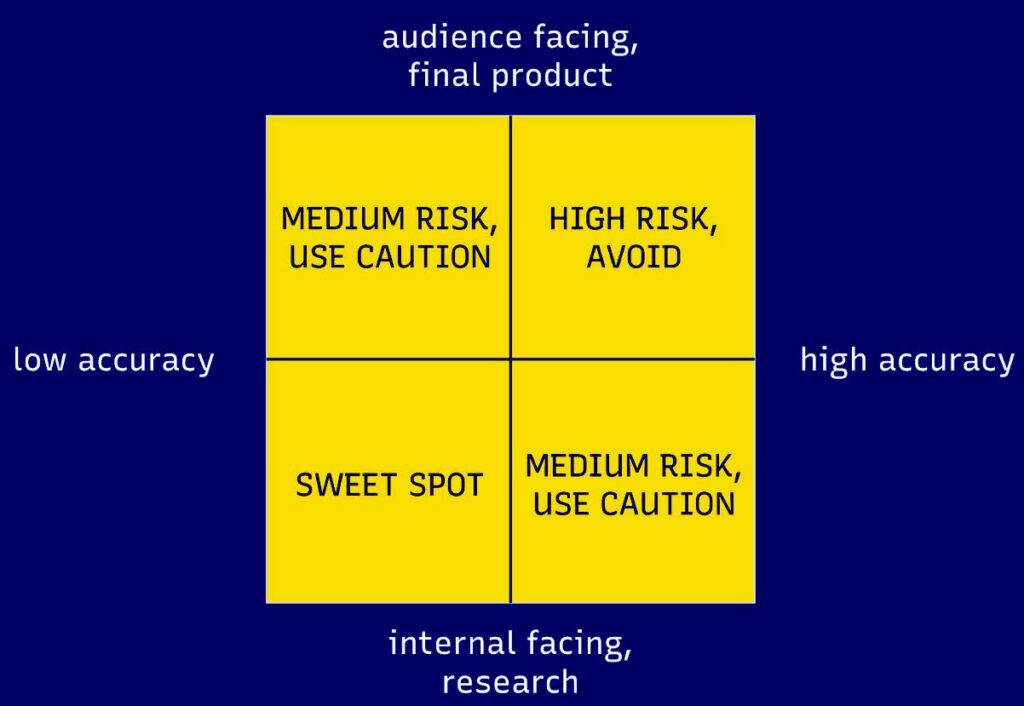
Vo emphasizes the importance of journalists educating themselves on AI and how it works in the newsroom to drive more ethical decision-making and help reignite audience trust. “Once you have a little bit of a better image and understanding and picture of what these tools are capable of and what the issues surrounding them are, you’re able to make much better decisions around how to deploy them,” she says.
It’s something Thomas thinks about all the time. “Digital influences are going to take over the new space. The question is, are we going to have them equipped? Are we going to be partnering with them or collaborating to get more credible information? Are we preparing for that future? If we don’t get a handle on this information space, we’re all going to be in a lot of trouble.”
