
Canadian satire is a sharp instrument for representation, both at home and abroad

Canadian comic Mark Critch is playing Donald Trump. He’s wearing an unflattering toupee, sporting a spray tan, and sitting in a gilded Oval Office opposite Mark McKinney’s sedated yet serious rendition of Mark Carney. The two men act out diplomatic pleasantries under the gaze of presidential portraits.
“First of all, a big welcome to Prime Minister Mark Carney. I like him, he’s a nice guy!” says Trump.
“Oh! You’re being nice; I was not prepared for that…I guess I’ll just speak from the heart,
if I may, sir, you are a transformative president,” replies Carney.
Flattered, Trump responds, “I like that! I’m like a big robot that can turn into a truck!”
Outside of the skit, the stakes couldn’t have been higher. Donald Trump had been repeatedly threatening Canada’s sovereignty and placed devastating tariffs on Canadian exports. Mark Carney, the man elected to deal with Trump, had since descended on Washington, no doubt feeling the weight of the responsibility bearing down on him. Billions in revenue could be lost, industries could crumble, borders could be redrawn. His task seemed impossible: make a reasonable trade deal with an unpredictable and vain, but powerful man. Whatever his response, Carney had to remain calm.
The two comedians tussle, exchanging politically charged punchlines. Suddenly, Trump offhandedly mentions making Canada the 51st state, setting off the usually docile Carney. He erupts, growling with rage, “You. Will. Never. Own Canada! You mango MAGA, clown-faced, Donald McDonald! You even think about reaching over the Saskatchewan border and grabbing us by the Regina, you’ll be sucking your Big Mac combos through a straw! That’s right! What’s up! What’s up! If I may, if I may. What’s up!”
Satire, like journalism, is a tool for highlighting the often-unspoken truths at the heart of events. It can address the increasingly complicated U.S.-Canadian relationship, the outward ridiculousness of Donald Trump, or the repressed frustration of Mark Carney. But above all, it represents how we feel about these things. Mainstream media, if it actually covers a given topic, often leaves any subjective assessments to highfalutin and frequently paywalled op-eds so as not to editorialize, offend, or misrepresent. Meanwhile, satire is fundamentally an act of approachable and truthful representation, one that seeks to address the reality of
the world around us.
The Shiv
Seated at a glass news desk, comedian Danny Knight is sharply dressed in a plain grey suit with decorative cuffs. The show’s logo flashes behind him as he welcomes viewers back to the Saskatchewan-based Indigenous satirical news show, The Feather News. In the trailer for the second season of the show, the team’s excitement is contrasted with a panicked editor behind the camera. “We’re a newsroom running on pennies,” says the editor, Gary. The trailer continues, Gary, still panicking, exclaims, “We’re gonna have to start selling drugs if things don’t turn around.”
As the show returns to APTN, its fictional characters reflect the very real feelings of Indigenous journalists in the industry, immersing the viewer in the stress of sustaining a struggling newsroom. Shawn Cuthand’s character tries to balance his personal activism with his reporting, while Knight’s character yearns for mainstream recognition.
The Feather News could have been a series of articles, or a drama, or a documentary, but satire is fundamentally a concealed weapon, and the show’s hijinks only lure you in to educate you later. Behind the veil of comedy, according to Aaron Hagey-MacKay, Canadian satirist and founder of The Goose, satire can “poke holes through the bullshit fabric that is pulled over people’s eyes.”
It’s what drew Ryan Moccasin, the founder of The Feather News, to adopt satire. While Indigenous representation in the media has never been adequate, through satire, he says, “You can deliver it right to the people and make some noise…. You’re not subject to an editorial authority at all. You are the editorial authority, so you can just ask any questions you want.”
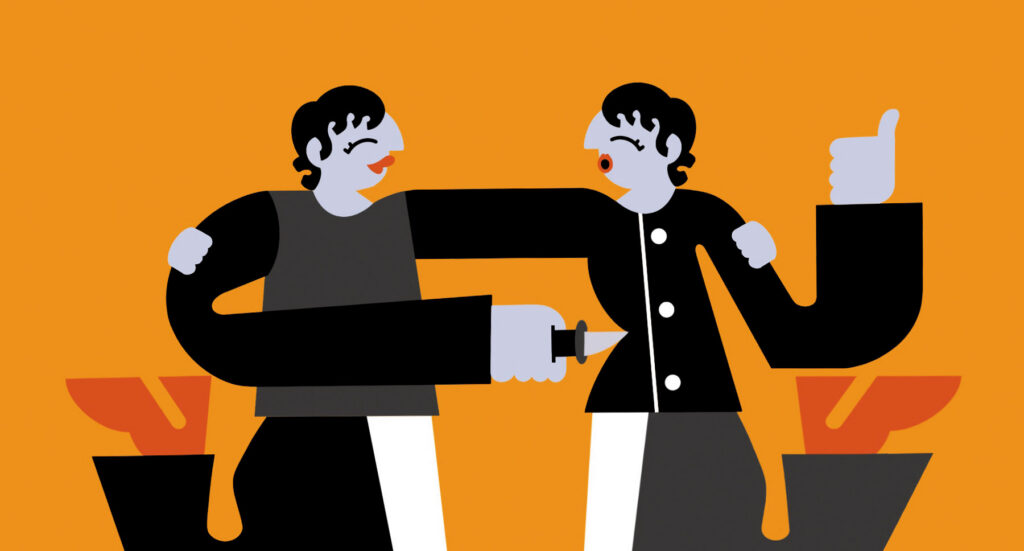
This ability to make noise and rock the boat might be even more noticeable in a nation like Canada. While Canadians are known for being polite and peaceful, this also produces a culture of denying the oppressive reality of both domestic and international affairs. Ian MacIntyre, a senior editor for Canadian satire publication, The Beaverton, believes there’s a special quality about Canadian satire and he attributes it in part to our passive nature. “Canadian satire will smile politely and shake your hand while it sticks a shiv between your ribs,” he says.
The Vultures
Growing up, Moccasin never thought he would work in television. After writing for the now-defunct publication Indigenous Times, Moccasin — inspired by The Onion and the work of Indigenous satirist Tim Fontaine — began working on satirical news articles and videos without any idea of what it might turn into.
Soon, he recruited stand-up comedians Shawn Cuthand and Danny Knight as well as editor and writer Muskwa Lerat, and the team started putting out short videos on YouTube. They caught wind of a web series competition hosted by ImagineNATIVE, otherwise known as The Centre for Aboriginal Media, and APTN. Figuring, “What the hell! Maybe we have a shot at this,” Moccasin encouraged Cuthand and Knight to pitch what they had been working on. To their surprise, they ended up winning the competition. They quickly signed a licensing agreement with APTN, and with that, The Feather News was born.
The Feather News covers a host of issues facing Indigenous communities, but one of the most central is the relationship Indigenous communities have with the Canadian news media. Moccasin argued that this relationship has been defined by distrust, as Canadian news organizations send journalists who fail to connect with the community they’re reporting on or just send in “their token guy.” Moccasin says, “They just go into an Indigenous community, grab those stories, and then they say, ‘Okay, bye!’ But there’s no plan to take care of the community. There’s no plan to continue that relationship. You’re basically just going in like a vulture, grabbing stories, and leaving.”
“Canadian satire will smile politely and shake your hand while it sticks a shiv between your ribs.”
As a result, the show covers this problem through its anxious WASP journalist Tanner. “He’s that white journalist who’s parachuted into this. He’s like a fish out of water. He’s like, ‘Oh geez, I’m in this new environment now, I’ve got to adjust.’ So, he’s kind of squirming; ‘how do I work alongside all these Indigenous people?”
Distrusting the news media and making fun of journalists is well-trodden ground on which several satire giants also stand.
As a stinger breaks the silence, a camera swoops into a soundstage, and viewers are whisked into the first episode of the 33rd season of CBC’s This Hour Has 22 Minutes. Stacey McGunnigle, in a stylish pink blazer, stands beside Trent McClellan in a crisp black suit. The two are seated at a news desk and an animated backdrop plays behind them. With an air of authority, they take turns announcing the breaking news stories they are about to cover.
This Hour Has 22 Minutes, The Feather News, The Beaverton, and others have all adopted the symbolism and nomenclature of the news media: anchors, desk, correspondents, editors, and headlines. This is ultimately a statement about public trust in the news. According to Statistics Canada, “Fewer than half of Canadians (47 percent) reported high levels of trust in the media.”
This relationship, among a host of other factors — all of which are not helped by mainstream journalists failing to engage with other communities or difficult topics — results in a lack of coverage. Jordan Foisy, the current head writer of Canada’s largest satire show, CBC’s This Hour Has 22 Minutes, says, “When you try to get a clear picture of the country, there’s a dearth of actual coverage and the coverage that does exist is pretty shallow…it’s much harder to do satire here because a lot of times you have to catch the audience up on things,” Foisy, clearly frustrated, continues, “Do you know how hard it is to make the notwithstanding clause funny? It’s fucking impossible.”
Indigenous communities routinely face this shortage. Outside of APTN and a handful of smaller publications, Moccasin says, “We weren’t really given our own agency or given our own freedom to report on ourselves.” As such, The Feather hired a former journalist to serve as a consultant on the show, resulting in a final product that Moccasin says explores “how a real Indigenous news network would look satirically, and how they would report on issues that affect their own communities.”
In a bulky winter coat and donning thin rectangular glasses, a reporter stands in a blizzard, snowflakes accumulating in his long dark hair. Holding a blue microphone adorned with an “i” stylized to look like the Superman logo, the reporter begins his monologue. He talks about the effect of Donald Trump’s tariffs on forestry jobs and everything seems completely normal. Then, the reporter asks, “Et que fait le premier pénis du Québec?” The reporter is Jean-René Dufort, otherwise known as Infoman. And like The Feather News, he is reporting on a story from his community. In this clip, “le premier pénis du Québec” refers to what a member of the Québec Liberal Party, André Fortin, recently called the Premier of Québec, François Legault.
English – and French-speaking Canadians are separated by what is known as the Two Solitudes. Despite living in the same country, Anglophones and Francophones can often be oblivious to what is happening in each other’s communities due largely to language and culture barriers. Pascal Justin Boyer, a French Canadian comedian, passionately argues that “this country is bilingual, but only for Francophones who are vastly more bilingual than their English-speaking counterparts.” However, Boyer also noted that this divide is a common topic of French-Canadian satire.
As a result of this disconnect, a powerful internal star system of French-Canadian references, celebrities, and shows has formed. This star system is unique, and something English-speaking Canada has yet to produce.
“Let me paint a broad picture. Schitt’s Creek. Several of that cast lived in the United States. The actual auditions took place in Los Angeles, but it’s a Canadian show because it was shot in Orangeville and whatnot.
That’s great. That’s beautiful. It’s fantastic, but having a star system implies that if you need them to go play a dumb game on CBC at six o’clock right after the news, then they are available,” says Boyer.
French-Canadian satire is a core part of this star system and frequently makes fun of Quebec’s internal politics, rural and urban communities, French expats, Americans, Anglophones, and even the cultural divide itself. One skit on This Hour Has 22 Minutes, for example, makes fun of Mark Carney’s poor French. On the flipside, skits from popular Francophone animator Têtes à Claques make fun of Québécois’ poor English. As such, French-Canadian satire represents itself before the vultures start circling.
The Zeitgeist
Struggling revenue models, shifting consumer behaviours, and rising costs for most expenses have ravaged news media organizations the world over. But being that satire and the news are so linked, the two face the same pressures.
We see the effects of these pressures as both formats make shifts in their content. Heidi Brander, an award-winning Canadian comic and former writer for This Hour Has 22 Minutes, says “Earlier in [22 Minutes’] tenure, it really tried hard to be a parody of a news show. But you look at it now, and it starts with two anchors at a desk doing political satire, but then it goes into a sketch about, ‘isn’t it crazy when your ex has your Netflix password?’” Ultimately, rather than maintaining itself purely as a critique of Canadian news media, Brander says that “the news is in the zeitgeist, and I think that 22 just wants to parody the zeitgeist.”
Meanwhile, we see this same shift in the Canadian news media. According to The Globe and Mail, readers showed interest in storytelling outside of breaking news and financial advice. As a result, the newspaper has strived to cover topics like wellness and culture, which has resulted in more views and more engaged readers.
“Do you know how hard it is to make the notwithstanding clause funny? It’s fucking impossible.”
A report for the Canadian Centre for Policy Alternatives found that almost 2.5 million Canadians live in a postal code with one or no local news outlets. As these media ecosystems collapse, the smaller, yet equally important stories are heard less and less. Tom Stanley, a producer and writer who worked on The Rick Mercer Report, argues that without a figure who satirically dissects the small stories of Canadian life, Canadian satire “mirrors local news decline; you’re missing so much without that local reporter. There’s lots to talk about up here without worrying about what’s south of the border.”
Even when working with international topics, focusing on a Canadian angle does best for both Canadian satirists and news outlets. MacIntyre adamantly states, “When we can come at something and show how this story impacts Canada, that’s always what does best for us.” For instance, when Trump first announced his tariffs on Canada, MacIntyre says, “I hesitate to say we got lucky…but it did certainly lend itself to us writing a lot of Trump articles with a Canadian focus, and as a result, we got a lot of traffic and a lot of views.” We see the same demand in Canadian news media, where Ipsos polling shows 85 percent of Canadians want “strong and independent news media that tells Canada’s story to Canadians.” However, the ways Canadians get these stories are changing.
Surrounded by fuchsia - and cream-coloured walls adorned with comics and Star-Trek memorabilia, Canadian writer, comedian, and satirist, Aaron Hagey-MacKay, talks to himself. A short video on his Instagram account, The Goose, made in partnership with advocacy group, Environmental Defence, shows two versions of the same man engaging in a conversation.
“Hey, remember Toronto back in 2008?” asks Hagey-MacKay to himself. “Yeah! Honest Eds, the Ossington strip becoming Hipsterville, average rent was only $1,000 a month. Myspace! Scott Pilgrim!! DANCE CAVE!!!” The two share a hearty chuckle and reminisce about the good times.
Then there’s a brief pause. “…This gas plant came online,” says one. “Yeah…wait, what? You’re nostalgic about a gas plant?” replies the other. Believe it or not, Hagey-MacKay has just begun to educate you on Toronto’s Portlands Energy Centre and how, despite the city council voting to close it, the province refuses to budge.
After grinding the Toronto comedy circuit for years, Hagey-MacKay launched The Goose. His wheelhouse of topics ranges from dissecting the manosphere to raising awareness on the problems with natural gas pipelines. Now he is one of Canada’s most brilliant satirists and a pioneer of Canadian satire in the age of social media.
He is not alone, as legacy satirical publications are also making the jump to social media. In fact, the host of This American Life, Ira Glass, has touted CBC’s satirical radio show Because News as “the only strong example” of a public radio show creating a “real audience” on social media. However, this coincides with a broader shift happening in Canada, where Kaiser & Partners found that, “Many millennials (66 percent) and most Gen Z respondents (85 percent) report seeking Canadian news on social media channels versus traditional news platforms.”
Ultimately, while it’s great that satire and the news media might just be nimble enough to change with the times, 11 percent of news outlets have closed since 2008. Canada’s satire scene is also a harsh environment, with giants like The Beaverton depressingly announcing that it’s “Dying. Unless You Save It.” Unfortunately, while other countries have thriving satire scenes, even when Canadian satire comes to fruition, it struggles. But why?
***
On a pleasant autumn weekend, a 61-year-old Ontario man named Doug was at Home Depot buying potted plants for his cottage. As he loaded plants into the back of his pickup truck, a hooded figure with a backpack darted out of the store, trailed by a furious store manager. Noticing the man was a shoplifter, Doug bravely took matters into his own hands. Ticked off, heart beating fast, Doug demanded to see his bag, and boldly told him, “I’m going to kick your ass all over the parking lot.”
Doug also happens to be the current Premier of Ontario. When news of his — some might call it heroism, others might call it a middle-aged man’s vigilante daydream — hit the headlines, Foisy and the writers at This Hour Has 22 Minutes quickly got to work.
“I wrote a scene that was just straight from Dirty Harry. ‘Are you feeling lucky, punk?’ But the way I wrote it [Ford] had a big gun, and at the end of the sketch, he accidentally blows the guy’s head off.” Foisy continued, “For some miraculous reason, that got picked and was going to get shot. Then a note came down.” Foisy knew it was a big risk and unlikely to be approved, so it was not shocking that the executives at CBC thought it was distasteful to show the premier executing a man in broad daylight, especially considering the assassination of Charlie Kirk had occurred the month prior.
While this is understandable, some satirists believe that tameness has plagued Canada’s public broadcaster. Hagey-MacKay, a longtime yet frustrated fan of 22 Minutes, says that “part of [the difficulty in producing satire in Canada] is due to the stodginess of the CBC to a certain degree, in that it’s the primary cultural institution. It had to appeal to literally everybody, and so it was very much afraid of taking risks. And that’s still true today. I have done things with CBC recently, and it was like fucking pulling teeth.”
While complaints like Hagey-MacKay’s are common, Brander pushed back. “22’s doing some pretty edgy stuff,” he says. “Leave them alone, and CBC too…. The only times I’ve ever felt like I’m working for a public broadcaster is when you can’t say the F-word…. I’m sure there is stuff that we haven’t been allowed to do, but I wouldn’t say that there’s no room for danger at the CBC.”
The perceived lameness of CBC is partially due to the dominance of American alternatives in Canada. MacIntyre argues that the proximity of the United States means “Canada is the only country where all of our top 10 and on downward are American shows, because America, culture-wise, is pretty close to us, and all of their productions are just exponentially better funded, bigger, and flashier.”
When the real Mark Carney awkwardly told Jon Stewart during an interview on The Daily Show that America and Canada could be “friends with benefits,” it struck me as odd that a prospective prime minister would announce his bid for Canada’s top job on an American satire show. But it shows the relationship Canadians have with American satire perfectly.
American satire is the largest in the world because of American cultural, political, and economic hegemony. This means the U.S. usually generates the headlines, and by and large, the satirical ones too. While Canadian satirists often mock this hegemony, it also means many Canadian consumers simply watch American satire instead of Canadian alternatives. This can be seen in the fact that Last Week Tonight, Saturday Night Live, and The Daily Show are among the top 10 most-watched shows in Canada.
Canada’s addiction to American satire has become increasingly hard to ignore in the past year, as Brander says, “These people are not buying anything American, but then everyone is still watching American TV. You know you could watch 22 Minutes instead of John Oliver?”
Very Polished Anger
Canadian satire, as Brander puts it, “is more subtle, it’s more observational, and self-deprecating. I feel like ours is ‘capital S satire’, it’s kind of wink wink nudge nudge…whereas American satire over the last couple of years has just been John Oliver and Stephen Colbert saying, ‘fuck you’ to the camera.”
Back in the Oval Office, McKinney’s Carney says, “Canada has three official languages. English. Fran…says? And passive-aggressive, backhanded compliments.” Trump, with his tie dragging on the floor, lips tightly pursed, replies, “It’s a beautiful language, isn’t it?” This short 22 Minutes skit, titled “Mark Carney Gets Nasty in the Oval Office!” exemplifies the material and tone of mainstream Canadian satire; subtly making fun of ourselves and Americans with composed rage.
Canada’s English-speaking majority often turns to represent itself in relation to the power that still dominates it, America. Jeet Heer, a Canadian culture critic, says that Canadian satire, because of our enmeshed geography, economics, history, and culture, is largely an expression of “double consciousness,” in which we can critique American society as flies on the border wall. As a result, Canada is often referred to as an observer nation.
Rick Mercer, the embodiment of the observer, is Canadian satire’s closest thing to a national institution. Starring in This Hour Has 22 Minutes, The Rick Mercer Report, and more, Mercer is relentless in his efforts to represent Canada, both to Canadians and to the world. MacIntyre remembers watching 22 Minutes with his dad every week. Sometimes, when they were lucky, the two would go to tapings of the show in Halifax.
Mercer’s 22 Minutes rant titled “USA Geography” best summarizes Canadian satire according to MacIntyre. Pierre Trudeau famously said Canada’s relationship with the U.S. is like an elephant and a mouse. But Mercer urges us to disregard this analogy. “America is not an elephant! For one thing, we are bigger than they are, and elephants never forget, but Americans don’t really know much to begin with.” Not only does this rant articulate the enduring relationship between the two countries, but it also shows what MacIntyre believes Canadian satire does best: “very polished anger.”
However, Stanley, who worked with Mercer for 14 years, says his knack for sharing uniquely Canadian stories is what makes him a legend. Stanley argues that by promoting mundane stories of Canadian life, Mercer inadvertently represented the larger Canadian identity. “When you…reflect the country, people will draw the similarities. It won’t be exactly the same, but something like that is happening in their town,” Stanley says.
Stanley recalls one episode of The Rick Mercer Report that exemplified this. Mercer had travelled to the historic fortress at Louisbourg, Cape Breton, when an eighth grader named Clifton joined him for an interview. Mercer asks him what he wants to see at the fortress, and the boy replies, “You…do stuff.” Mercer is taken aback; he himself didn’t even know he would be visiting until two days prior. When Mercer asks him how he knew he’d be there, Clifton responds, “My Mom found out at the liquor store.” Stanley remembers the moment as a universal celebration of mundane Canadian life.
Our politeness, for which we are internationally renowned, is a theme frequently found in Canadian satire. In a 22 Minutes sketch called “N.I.C.E Agents,” Trent McClellan dresses as a fake border patrol officer, approaches American tourists, and berates them with civility. In fact, Heer argues that polite Canadian satirists, comedians, and political commentators only do well in Canada.
But Canadian satirists will also rebel against this. MacIntyre argues that “Canadians are always known for being polite and harmless, but we’re also all too aware of that, and so churning just beneath the surface is a constant resentment at Canada being underestimated, usually by our American neighbours.”
This challenge to be seen is one that French-speaking Canadians have always fought for domestically, and one that satire is helping to remedy. As a part of the Francophone star system, French-language satire remains strong with Jean-René Dufort’s Infoman, heavyweights like Le Bye Bye’s satirical yearly round-up of events, and the talk show Tout le Monde en Parle.
The last one is one of the biggest shows in Canada, pulling in millions of viewers. Based on a now-defunct French talk show by the same name, Tout le Monde en Parle has continuously been a force for Francophone representation. According to Boyer, “Everybody wants to go there. The political class wants to go there, the artistic community wants to go there, public interest groups want to go there. It’s kind of a common reference that everybody can look up to.”
While there are likely many Canadians who have not heard of it, Boyer argues that what makes French-Canadian satire even more unique is the fact that it’s an inside joke, and many satirical references would stump most Anglophones.
After noticing my Albertan phone number and poor French pronunciation, Boyer said, “There’s a few things I could say right now that you would never understand.” He asked me if I knew about Dominique Michel leaving Le Bye Bye. I didn’t. Graciously, he forgave my ignorance, and explained that each year Michel makes a show of stepping down, before inevitably returning for the next installment. This itself has become an inside joke in Quebec.
Le Bye Bye is the satirical centre of Quebec’s star system. The show has aired every year on New Year’s Eve since 1968 and sees Québécois comedians performing sketches that satirize the past year. Its content varies depending on current events, but the show has generated both adoring fans and controversy over its time on air. For instance, its 2008 edition received significant flak after airing a racist mock interview portraying American President Barack Obama.
Carmina Berbari Daou, a stand-up comedian based in Montreal, describes French-Canadian humour as eccentric, absurd, and self-referential, often taking facets of everyday life and revealing the bizarreness hidden underneath. Caricature and stereotypes are long-established tools of Francophone humour and satire, with shows like Têtes à Claques being a prime example. Above all, she states that rather than English-speaking Canada’s militant politeness, Francophone humour embraces vulgarity.
Berbari Daou describes the difference as such. Quoting fellow comedian Gino Durante, Daou says when an English-speaking Canadian walks into a room, no matter how formal, and smells a foul odour, they will politely say something along the lines of “Oh, it’s a little stuffy in here.” However, when a Québécois walks in after them, without intending to be uncouth, they will say, “Ça sent le cul ici,” or, “it smells like ass in here.”
Meanwhile, Boyer explains that while French-Canadian satire’s tone is rarely soft-spoken, regardless of whether it’s directed at English or French speakers, it is still generally kindhearted or bienveillante underneath.
While Francophones have an established star system from rebelling against WASP dominance in Canada, Indigenous communities are still fighting for representation, and satire has become a tool to tackle large-scale issues such as national politics, the legacy of historic figures, and relations with other countries.
Moccasin uses an example from season two of The Feather News. “We joke around with Justin Trudeau bringing back The White Paper. The White Paper was something introduced by his father, Pierre Trudeau, in the 1960s, that Indigenous people were vehemently against because it would extinguish all treaty rights and integrate Indigenous people into the Canadian political fold…. So, when we approached that, we did our research. We looked at what happened back in the sixties and how it would play out now. But how do we contextualize that for the audience? Even though the larger issue is that Justin Trudeau is bringing back his father’s legacy, how would that play out in an individual community?”
The choice to use satire to discuss hard topics stems from what Moccasin calls satire’s “diplomatic” ability. “Comedy is the shortest distance between two people…it puts people’s arms down when you can make them laugh about something, and it’s a really interesting way to open up a conversation that wouldn’t happen otherwise.”
Moccasin goes on to describe a recent show he and The Feather News crew gave at Little Pine First Nation.
During Addiction Week, Cuthand, Knight, and he went into a community of people trying to stay sober. “I found that we had to have fun with dark humour. Not so dark where it’s like, ‘you shouldn’t have said that,’ but I think that it’s like that old adage, that laughter is the best medicine,” says Moccasin.
He continues, “So even though Indigenous people do have a long history in this country that is not the brightest with non-Indigenous people…we do find moments in these shows, where we just like to have fun and laugh about it, because I think that’s the only way you can heal from it.”
