
The Fifth Estate’s documentary into Missing Black Boys centred community at its premiere. Could this be a way forward for investigative journalism?
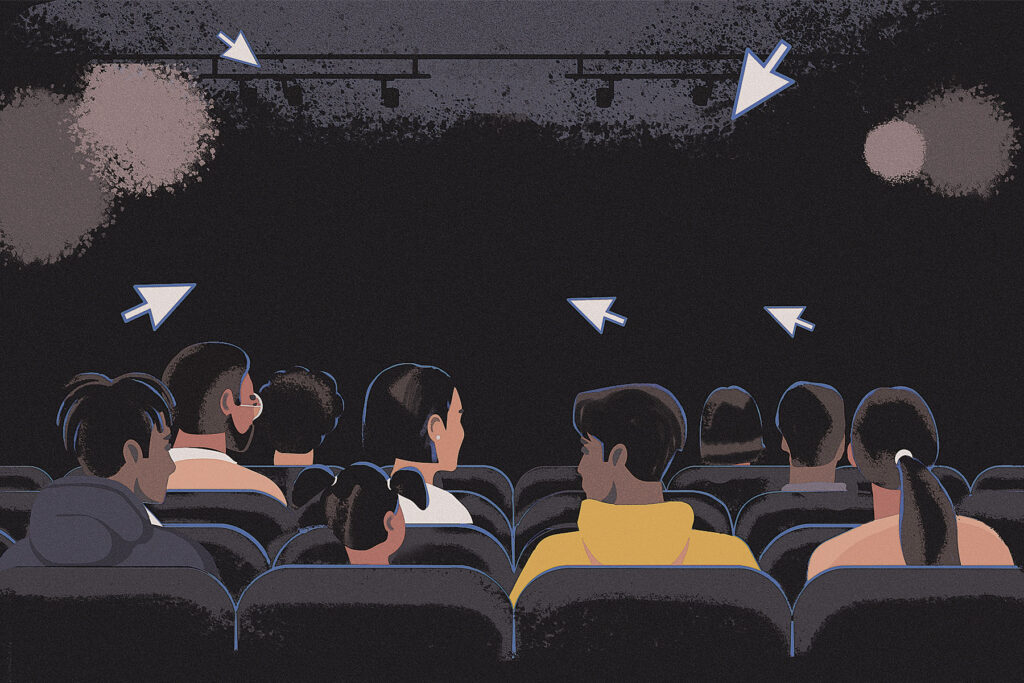
Four rows up from the small yet well-lit stage, Jason Patino stands up in his seat. Taking the microphone from an usher, he turns to face the audience.
“I don’t really have a question,” he says.
Pausing for a moment, Patino gestures around the room confidently, scanning his environment and making purposeful eye contact in a room full of community members. Patino knows some people, but not everyone. “There’s a lot of parents here,” he continues. “All of us come from a Caribbean background.”
A documentary screening of Missing Black Boys, a Fifth Estate production, has just finished airing. There has been a community-based discussion about how young Black boys are being targeted by drug traffickers and lured from their homes in southern Ontario into small towns further North. There is distress among community members, and a sense that people need to come together to act.
“You might feel ashamed,” Patino says. “You might feel alone.”
He takes another deliberate pause.
“Don’t be quiet about this. We’re a community, and everyone needs to work together to solve this problem.”
A round of applause ensues at his words. Parents, journalists and other audience members shift in their chairs, incline their heads. There is urgency in his voice, and conviction.
“One of the main things is that if you have a young boy, you have to be watching them. You have to be paying attention,” he says. But for all of us, the young Black boys going missing in Ontario is a concern; for now most of that concern is being driven by grassroots efforts to demand attention.
“If someone goes missing,” Patino says, “contact a neighbour. Speak to someone else. They might know someone you can get in contact with, someone else that you could talk to who might be able to help.”
Hands clap, people nod in assent.
***
It’s January 21, 2026 and a snowstorm is underway, affecting neighbourhoods across the Greater Toronto Area (GTA). At 6:30 p.m., it’s pitch-black outside and the snow is coming down in sheets. Yet, the theatre room inside the St. Francis Centre for Community, Arts and Culture — a converted red-brick church in Ajax — is packed to the brim.
From what I can tell, the majority of the evening’s audience are not journalists, but members of the Durham region community, outnumbering the CBC executives and the Fifth producers five to one, if not more. It’s an intimate setting for a sobering documentary about young Black boys lured from their homes.
“This is a really sensitive issue. It’s about family. It’s about young children, and so we wanted that intimacy in the space,” says Allya Davidson, the executive producer of the Fifth.
Public outcry around Black boys going missing from the GTA started growing in 2024. Emma Ansah, a journalist with the African Diaspora News Channel, was one of the first to sound the alarm on the network’s YouTube channel. Around the same time, Shana McCalla, a radio host, began advocating for the boys’ safe return on social media, attending countless public forums and amplifying the voices of concerned parents and loved ones. McCalla started a petition directed at the solicitor general, the minister of justice, and the minister of public safety in December 2024. It amassed more than 14,000 signatures.
Other journalists begin to take note, too. In March 2025, Camille Dundas, the cofounder and editor in chief of ByBlacks.com, a leading Black Canadian online magazine, penned a piece centring the issue.
Noting the efforts of Ansah and McCalla, Dundas writes, “But after several community town halls organized by McCalla and a string of other news media stories, there’s been no public update on what happened to these boys.”
The Fifth team began to take notice. Their investigation took nearly a year to produce and came to a head in the evening’s premiere at St. Francis Community Centre.
***
A lot of care went into the Fifth’s decision on how to launch the documentary. It seemed to Davidson that the event needed to be something more inclusive.
“It just spoke to the need for this event, the desire for this event, for people to sort of engage together in person,” she explains.
In fact, when the team launched free tickets to Missing Black Boys: A Community Conversation on Eventbrite, tickets were claimed in a day and a half. While the team had planned radio hits, newsletters, and similar promotional activities, Davidson says they didn’t need to do any further advertising after the seats were filled so quickly.
The event in Ajax is one of the first community-based events of its kind to be hosted by the CBC show.
Historically, it’s been uncommon for mainstream news journalism to consider the value of community in a sustained way, says Dr. Gabriela Perdomo Páez, editor-in-chief at J-Source and an assistant journalism professor who teaches community-engaged journalism at Mount Royal University.
While engaged journalism “has always been at the heart of many grassroots and independent news organizations around the world,” she says the dominant approach in a “North American, kind of Anglo-Saxon setting” has been to play the observer. When coupled with the myth of neutrality, this can leave newsrooms with a distanced view of what stories matter.
“That’s definitely a tension with that idea that you have to go in with your own framing of the story, extract the story and leave…so listening comes in and gets into tension with that kind of watchdog [attitude],” Perdomo Páez says.
Derek Hrynyshyn, a media studies instructor at York University is of the same view. Historically, mass media, print media, and traditional broadcasting have produced content designed to attract the largest possible audience, he explains. While this wasn’t always the case with niche publications, news organizations have conflated this with serving the public interest, meaning “stories that didn’t fit into a narrative that the public was already familiar with would often be marginalized.”
What does drive excitement around audience engagement has largely been tied to ad revenue.
Perdomo Páez says we face a conundrum. On the one hand, we’re completely immersed in the digital ecosystem, and what drives the most hits — and attracts advertisers — tends to be more polarizing. But on the other hand, tech-driven insights into audience behaviour have been important for journalists to understand what matters to the public, to communities.
“Of course, journalism needs money to survive,” says Perdomo Páez, “so economically every newsroom needs to know how to cater to their audience.”
While CBC receives much of its funding through federal grants, it also relies on advertising revenue. CBC’s TV and digital ad revenue depends in part on the “success of its programming schedule,” but some of that success is dictated by the broadcaster’s share of the audience. According to data from Numeris, Mediamix, and Comscore, across all its platforms, the CBC/Radio-Canada group reaches nearly eight Canadians out of 10 each month, or more than 31.9 million people.
So it is reasonable to assume viewership will inform what gets promoted on the network, or what is deemed of interest to the Canadian public.
And to the extent that CBC supplements some of its funding with commercial revenue, critics maintain that prioritizing market share could lead the public broadcaster to stop taking risks on less popular, “more ambitious, stimulating, or unconventional” content.
CBC is, first and foremost, a publicly funded body and its self-professed raison-d’être is that its programming ought to be relatively free from the profit incentive. While the organization does look to make money through advertising and investments, they strive to put that revenue back into the economy. But private players still factor into its “media ecosystem,” and as the broadcaster rushes to meet people on the platforms they’re using — including its own streaming app, Gem — it’s put some network programs like its 24-hour news channel, CBC News Network, behind a paywall.
Back in the days of print, news organizations knew “very little” about the public, explains Marc Edge, an associate professor of communication at University Canada West and the author of Tomorrow’s News: How to Fix Canada’s Media. “It wasn’t really until broadcasting came along that survey research began to be used…so this resulted in target marketing.” He says Google and Facebook perfected this strategy through gathering data on their users.
To understand what’s resonating or “hitting,” newsrooms often look at audience data, using metrics like clicks and watch time to make editorial decisions about what — and whose — stories to tell. However, stories don’t always trade in the same digital currency. Public interest issues need to be on the record, yet won’t necessarily drive the kinds of numbers that sensationalized content, celebrity stories, or trending news do.
Bryan Maloney, director of engagement at The Walrus, says “[the media] just got a little too insular looking, you know, like focus on this audience. This is the growth audience, and [we] left a good chunk of people behind.”
Defining community can, of course, be challenging. In the Fifth’s focus on engagement with Missing Black Boys, the community anchor is specific, intentional, and tied to the story. But that clarity around “underserved communities” isn’t always clear either at the organizational or policy level.
For instance, in 2019, the federal government launched the Local Journalism Initiative, a $70 million fund to support “the creation of original [civic] journalism that is relevant to the diverse needs of underserved communities across Canada.” The government defined underserved communities by geography, calling them news deserts — where citizens in a given region lack access to information about community issues because there is no community media present — and areas of news poverty where there is limited access to information about issues that matter to the community because they are not being covered by the existing media.
Researchers Magda Konieczna and Béatrice Girardin say the government approached this gap by increasing the visibility of news organizations rather than “explicitly serving those already underserved communities,” or providing specific guidelines as to how these organizations can better identify and meet their needs.
***
Should newsrooms be investing in a whole different strategy around understanding the audiences they claim to serve?
This is the kind of perspective that the Fifth demonstrated on the evening of January 21. While CBC’s flagship shows have held live discussions around systemic issues before, like The Current’s Facing Race series, these discussions are typically hosted at the broadcaster’s studios; in the case of Facing Race, at its hubs in Vancouver, Montreal, and Halifax.
Others, like the Fifth’s 50th anniversary party, have been held at public libraries. These locations typically come with security measures and a more scripted feel; they are conversations staged on institutional turf.
But community members rarely feel centred in discussions about stories that directly impact them. In hosting an event like Missing Black Boys: A Community Conversation, CBC was breaking new ground.
Raymond Murray was in the audience for the screening. It was no Grammys, he says, no big, flashy, pomp-and-circumstance affair, but by virtue of how the evening was structured, he expects it will “have shockwaves in the community.”
“I was really moved by the conversations…all those people that participated came out in the midst of a snowstorm, like it was, it was a great event,” he adds.
Murray is an entrepreneur and program manager with the Durham Region Association of Black Professionals and Entrepreneurs (DRABPE). DRABPE was one of several local organizations to present about programs and support groups aimed at empowering Black youth, parents, and community members.
For him, the documentary hits close to home.
“Our youth are at risk, and to see the CBC cares enough to make that story known, and for someone that lived through it like me to come back and watch it now…it was heartwarming to see the community cares,” Murray says.
The Fifth team agreed early on that the event had to be held in the Durham region.
“You know, when I was planning this, people asked, ‘why aren’t you having this at the Broadcast Centre?’ But for me, it was really important, especially when we’re talking about the Black community, which is historically underreported or incorrectly reported by just media broadly, to go to the community and say, ‘You know, hey, here’s this piece we’re bringing to you first. We want you to see it where you live. It’s about your area,’” Davidson says.
Davidson’s boots-on-the-ground approach to engagement is a step in the right direction for the public broadcaster, which, along with most mainstream news outlets, has increasingly adopted a digital-first attitude toward the business of audience.
***
One of the pillars of the broadcaster’s five-year strategy to “create public value” is to be more “digitally agile,” meaning being online where audiences are and improving its data capabilities to “better understand audience segments.”
“As Canadians’ media habits change, we are transforming our business to reach them on the platforms they choose,” CBC declares in a recent financial report.
While this new strategy also prioritizes creating “connections across different segments of society and generations,” and building “partnerships across the media and cultural ecosystem,” digital reach has been, and remains, a gold standard for gauging where public attention lies.
The legislation that governs CBC/Radio-Canada, the Broadcasting Act, dictates that the national public broadcaster should “through its programming and the employment opportunities arising out of its operations, serve the needs and interests of all Canadians — including Canadians from Black or other racialized communities and Canadians of diverse ethnocultural backgrounds, socio-economic statuses, abilities and disabilities, sexual orientations, gender identities and expressions, and ages.”
Yet, publications’ over-reliance on clicks as a measure of their audiences’ sizes and interests limits who is seen as an audience member.
“There have been strides when it comes to media organizations changing the way that they do their stories, changing the way that they frame stories…but I think it still remains that there is a dominant character, a dominant person, and a dominant sector of society that is catered to in our news,” says Nana aba Duncan, Carty Chair in Journalism, Diversity, and Inclusion Studies at Carleton University’s School of Journalism and Communications, and the director of the Mary Ann Shadd Cary Centre for Journalism and Belonging.
According to the Canadian Association of Journalists’ (CAJ) 2025 diversity survey, 69.1 percent of newsrooms have no visible minority or Indigenous journalists in a top leadership position. 75 percent of supervisors at CBC News are white, with the same percentage accounting for CAJ’s sweep of the industry. This means white journalists are overrepresented both in managerial positions and in the field as a whole.
One of the Canadian Association of Black Journalists’ and the Canadian Journalists of Colour’s call to actions for Canadian news media is to “formally consult with racialized communities about news coverage on an ongoing basis.”
“Opening these doors, literally and figuratively, that can have an impact on people’s lives. I just wish we’d see [mainstream media] do more of this,” Brian Daly, assistant professor and associate director of the School of Journalism at the University of King’s College, reflects. “That would be an example…of a whole reimagining of the relationship between journalists and the public.”
Davidson says she came across community concerns about Black boys disappearing on social media, but Shelley Ayres, who produced the documentary, pitched the story to her before she could assign it. By that point, Ayres had already gone to town halls and met with two or three parents, laying the groundwork for an enduring relationship with the community.
“So there was a genuine sort of commitment on her part…. It wasn’t sort of, you know, what’s up next? What’s my boss giving me next? It was, I really want to do this. I really think the show should do this,” she says.
***
Several of CBC’s local bureaus such as CBC Calgary, do centre community engagement in their editorial strategy.
In Nova Scotia, the province’s Black residents may apply to sit on a community advisory board for a two-year term. Established in 2023, the board meets virtually every few months to provide advice about specific reporting projects and long-term editorial outlooks, as well as offer general feedback on CBC programming. Members may also be asked to “serve as a sounding board” during breaking news events.
“It’s the notion that…the journalists, the journal, the media, have a duty to serve the community,” says Daly. “To the extent that media companies are going to listen to what people have to say, [advisory boards] can be very useful.”
But locally produced content gets picked up by network television, radio news, and digital teams whose focus is partly to make these stories relevant to a national audience.
By premiering the documentary in the community most impacted by the story, the Fifth, a national investigative program with over 50 years of history, makes a decided shift when it reimagines this approach, setting aside some of the pressures of numbers and eyeballs to first invest in community.
This pressure of numbers is very real. In a joint paper studying the impact of audience-oriented journalism, Nicole Blanchett, Colette Brin, and Stuart Duncan distinguish between quantitative data — metrics that measure audience behaviour on websites and social media — and qualitative data, like social media comments. The journalists they spoke to confirmed “the importance of audience data in the selection, development, and promotion of stories and in measuring their value.”
Page views, a quantitative metric, is frequently used to gauge how well a story has performed, and what content will drive traffic.
There is much discussion that other engagement metrics like time spent are more important than page views, they write. Yet many advertisers still look for proof of reach in clicks, and “digital editors sit cemented to monitors, working to decipher what stories have or are gaining traction.”
At CBC, for instance, About That is one of the most plugged programs on the network. In the daily TV show, according to its description, host Andrew Chang “goes beyond the headlines and explains the major news stories everybody is talking about.”
On YouTube, Chang’s videos regularly receive over hundreds of thousands of views. The show is built around what people are clicking on, but because of the traction it has gained online (especially among younger audiences), it’s framed and touted as a massive value add for the broadcaster’s public-facing mission.
Irene Thomaidis, the acting managing editor of digital publishing at CBC News, says in terms of what content gets promoted on CBC’s website, the broadcaster’s goal is to “best reflect the country.” Thomaidis says representatives from CBC’s social media division will tell editors “what’s trending” based on information from Google Trends, Reddit, and Ask CBC — an internal team that gathers and answers audience questions mainly online and over
social media.
“Everyone on digital has a good sense of what’s hitting and what’s not based on the metrics we can see in real time,” she says.
“I call it fishing where the fish are.”
***
After the documentary airs, the production team takes their place onstage. It’s the first of two back-to-back panels moderated by Brandon Gonez, host of the Brandon Gonez Show and CEO of Gonez Media Inc. One of the Fifth journalists points out the challenge of obtaining focused data to help illustrate the systemic forces behind the alarming number of Black boys vanishing; for example, police statistics, municipal data about youth unemployment, and age-specific dropout numbers from school boards.
Most, if not all, of the questions posed to the journalists deal with pieces that are missing, or questions left unanswered. Who are the human traffickers at the top of the drug trade pyramid? Why was there no response from the Durham police service? What mental health supports are available to the boys who are found?
It’s the panel that follows a 15-minute break that really fills in the information gaps.
The second panel is entirely made up of community members, several featured prominently in the documentary: O’Shea Stewart, a school counsellor and social worker in the GTA, Camille Dundas, Emma Ansah, and Shana McCalla. There is also Jason Miller, the crime and justice reporter for the Toronto Star. They have been organizing, advocating, and demanding justice for months.
“We work on our docs for a long time, relatively, but the activists who are on the ground, we have nothing on them. You know, five years, 10 years, whatever it is, they have the expertise. They understand the nuances [intimately],” says Davidson.
By Q&A, a palpable connection has formed between the second group of speakers and the audience. Their answers are illuminating, centred on confronting the systemic forces driving the crisis and resources available to parents, educators, and youth.
“I think in the past, some of the missteps, perhaps mainstream media broadly, has made,” Davidson mulls, “is when we sort of go in and, you know, discover something that is very much exists, and the people who are part of it very much know about it and report it as this thing we’ve discovered.”
These relationships built with people closer to the story help inform the public broadcaster, rather than being extractive or going uncredited. And while the event showcases both the work of journalists and community activists, Murray says the second panel felt more personal.
“The second panel could come with more solutions, because they lived through it, and they grew out of it,” he adds.
“But I don’t blame anyone, man, like, I see it’s not gonna happen overnight, not gonna happen through one documentary, as long as we keep doing it in part two, part three, more conversations, you know, get global with it.”
Patino also knows this is true.
“This won’t be solved by the police,” he says gravely, his eyes locked on the audience. “They obviously have shown that they don’t care…. So everybody is here for whatever reason, but please, we need to come closer together and talk about these things so that our children don’t go missing anymore.”
Moments later, people mill between rows, hugging big winter coats to their chests. Despite the outside temperature and the serious subject matter, the air inside is cozy and light. People chat animatedly about the documentary, introduce themselves to the attendees seated beside them, and find old friends in the crowd. The mouthwatering smell of Jamaican patties wafts over from the entrance and little plastic cups of pop are passed around.
There is hope, a coming together, a sense that something needs to give — and maybe this is a good place to start.
What can audience analytics tell us?
Timing out, or Time on Page (ToP)
ToP can be used to measure how long readers spend on a digital story, in the off chance they make it to the end. Kidding, but if they leave the tab running — to doom swipe on TikTok, for example — this will skew the metric, and probably your best guess at their reading comprehension level.
Spot the Bot: Page views and Total Watch Time
Both page views and total watch time (e.g. on a YouTube video) can be exaggerated by fake browsing behaviour, or bot traffic. And by bot, I am not referring to “a horrible player in a game” (thank you, Urban Dictionary) but automated tools that can mimic human actions like mouse movements, scrolling and clicks, sometimes used to commit ad fraud.
Qualitative-ing, Quantitative-ing but also Offline-ing
Qualitative audience research can include tools like surveys, focus groups, and user journey mapping. These methods can augment your quantitative findings and help you develop a more detailed understanding of your audience’s expectations and needs — but only the audience you’re already reaching. Ideally, your public interest quest will also take you offline.
