
Last year, at age 20, I tried to become an MP. Unsurprisingly, I lost
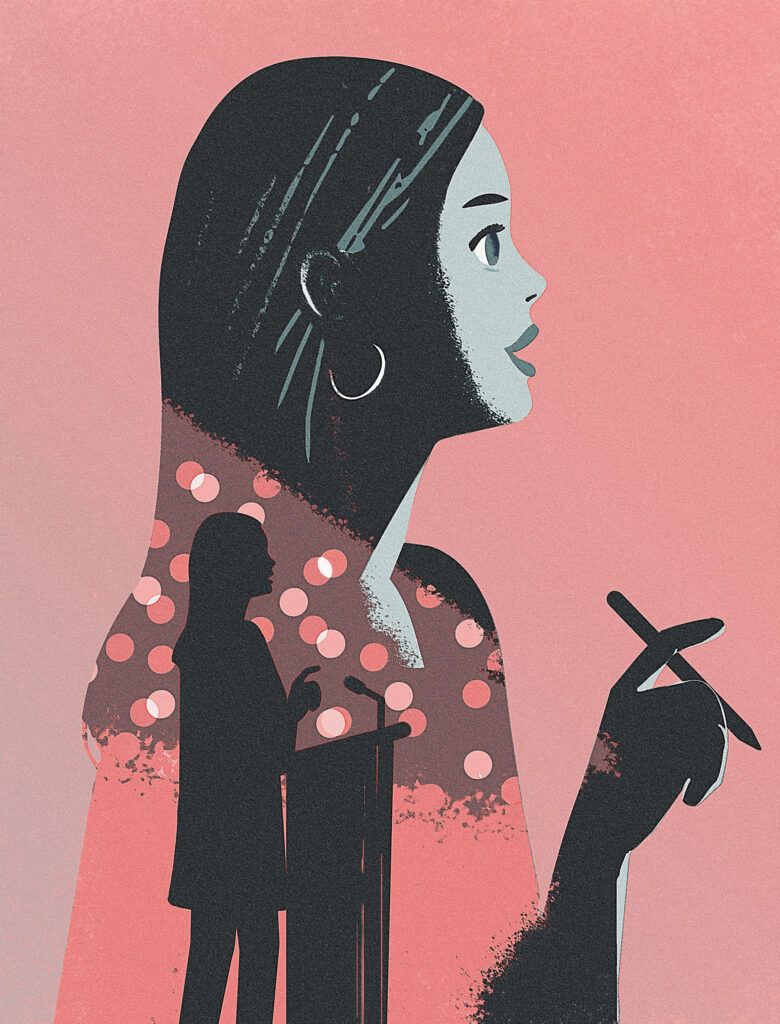
I was running as an NDP candidate in my own riding, the newly created Oakville East, an area where the party had never even come second. Undeterred, I stuffed my closet with orange and leaned on what I’d learned from the three years I’d spent at community events, knocking on doors, and volunteering. Politics was embedded in my life.
I’m also a journalism student who spent those same years gathering bylines, hoping to eventually find work in an industry where the norm is policies that forbid journalists from holding political party affiliations. At The Toronto Star, for instance, “editorial staff should not hold elected political office, work on political campaigns, or write speeches for political parties or officials.” At The Canadian Press, “all staff, especially our journalists, must avoid participation in partisan political activity at any level.” It’s similar across the board.
These policies weren’t a surprise to me. I still pursued both because I saw value in all the work I was doing. I’m far from the first. For me, and for many of the journalists-turned-politicians I’ve spoken with, it’s often the same principles that motivate us to become journalists — curiosity, idealism, determination — that prompt us to seek public office.
I sought out these current and former journalists wondering if I’d already destroyed one potential career by pursuing the other, or if I would come to regret my choice. Speaking to them about their paths and my own opened my eyes to the historical ties between journalism and party politics in Canada, and the inherent bias in the work we do.
***
For long as journalism and electoral politics have existed, they’ve been intertwined, though the relationship between the two has shifted significantly. The Globe and Mail was founded in 1844 by George Brown, one of the Canadian “fathers of confederation.” William Lyon Mackenzie, later the first mayor of Toronto and leader of the Upper Canada Rebellion, began the Colonial Advocate. He also criticized the editor of the Upper Canada Gazette, Charles Fothergill, for being the King’s printer — the official publisher for legally mandated government materials — as well as a member of Parliament at the same time. Of the three people who could be considered party leaders during the first federal election in 1867 two — Joseph Howe and George Brown — were journalists.
The third, John A. Macdonald, helped start a paper to support his messaging, including railway expansion, until the paper “declared independence” in the 1880s. Even after there was a cultural shift towards greater editorial independence, newspaper directories, which recorded the names and details of Canadian publications, listed the political affiliation of each one. News was used to influence the public narrative and the way people voted. The 1899 directory of Canadian publications states that “the great fault of the Canadian press has been that it was political rather than national…. Irrational devotion to party can hardly be consistent with rational devotion to country.” Even as recently as 1912, the Vancouver Sun was founded by the local Liberal association to fill a gap in the politics of the newspapers in the area.
The shift to more objective reporting happened slowly and globally, in part due to the demand for news during the First World War. CP was created in 1917 to meet that need, allowing different papers across a geographically massive country to exchange information. The pipeline debate of 1956 further altered the Canadian media landscape. The financing and environmental issues related to the construction of a TransCanada pipeline triggered aggressive debate and led the press to take on the more familiar adversarial and watchdog roles it now occupies.
And yet it is still not unusual for journalists to run for office. Just last spring, longtime journalist Evan Solomon won his campaign to be Liberal MP for Toronto Centre. Solomon worked on CBC’s Power and Politics until 2015, when he was fired after violating their conflict of interest policies. Not because of political affiliation, but because he was arranging art sales to people he’d interviewed, including now Prime Minister Mark Carney.
Three of the four most recent Toronto Centre MPs have been journalists. Among them is former cabinet minister and award-winning journalist Marci Ien.
Ien worked as a news anchor and reporter for decades before stepping down from her position as a host on CTV’s daytime talk show The Social to run in the 2020 Toronto Centre by-election. She never thought she’d want to run for office. “In fact, politicians were my least favourite interviews because they didn’t answer my questions most of the time.”
She says she only chose to seek office after Justin Trudeau personally called her. “He said, ‘I’m giving you the opportunity to be able to shape policy that’ll last generations.’”
At the time, she’d also been thinking about whether she was doing enough. “The pandemic was just getting underway. We didn’t really know what we were dealing with, so there was a lot of uncertainty. George Floyd had been killed. Every day, there was a sea of protesters around the world protesting at injustice…and so I talked to my kids, and I decided to throw my hat into the ring.”
For Allan Thompson, director of Carleton’s School of Journalism and Communication and former Star reporter, the idea of political office had been a long-time draw. In fact, the thought had crossed his mind well before he ran for the Liberal Party of Canada in Huron-Bruce in 2015 and 2019. “I decided no, I think I’ll continue with journalism, try to do more in that profession before leaving it to run for office,” he says. “But the two things were always in the back of my mind.”
***
My path to running for office wasn’t one big step. It was a series of them. I was 18 when I sent the NDP my social media data, a list of the crimes I’d committed — none — and most of my personal information. My journalism milestones, like bylines, or being shortlisted for an award, came paired with political ones: an executive role in my riding association, and being approved as a potential candidate. I officially became the Oakville East NDP candidate in August 2024.
“All newspaper writing has a point of view, and sometimes it’s more hidden than others.”
I’ve spent a lot of time grappling with my own obvious bias and the implications it might have. I know that my storytelling choices are informed by my interests — unions, healthcare, public transit, housing. Most of that also aligns with my party’s policies, even if I haven’t intentionally pushed the agenda.
“I’d always been known as a left-wing journalist. But it’s different if you’re associated directly with the political party…. I couldn’t really return to journalism as I practiced it,” says Linda McQuaig, two-time candidate for the NDP in Toronto Centre, who came second both times. McQuaig has been a reporter for the Globe, CBC, and Maclean’s, as well as a columnist for the Star. She had to convince the Star that she had no intention of returning to politics after the 2015 election. “They might not have taken me back if I’d been a reporter.”
But, as McQuaig, teases out, one’s perspective is evident in the stories and angles that one pursues. “In the selection of the topics you choose, you’re showing your viewpoint,” says McQuaig. “All newspaper writing has a point of view, and sometimes it’s more hidden than others.”
During the 2025 federal election, I scrutinized every piece of coverage and ran through ways stories could have been told differently. I found myself both an insider and an outsider: rightfully restricted from reporting on that particular moment because of my candidacy, but trained enough in journalism to see the routine decisions being made about what was and wasn’t newsworthy.
In April 2025, Mohamad Fakih, the Paramount Foods CEO, Order of Canada recipient, and previously vocal supporter of the Liberals, was expected to make a “significant endorsement” of Jagmeet Singh and the entire NDP — he didn’t. He did say that he was strategically voting for me, the NDP candidate, in order to take a stance against Liberal incumbent Anita Anand’s approach to Israel’s war on Gaza. I noticed that local news outlets didn’t cover the endorsement.
I’m not equipped to make a value judgment on why they chose not to report on it, whether they thought it was unimportant, or even if they didn’t know it happened. It’s still political. Every time an article is published, or not, someone is making a decision that will have an impact on the public. This raises a question of how well we serve the public. A poll conducted by Ipsos found that 56 percent of Canadians say that greater availability of local news could have impacted their vote in the 2025 federal election.
When Ien jumped into politics in 2020, she says the cameras didn’t show up until election night. Her former employers at CTV feared covering her would look like a conflict of interest. “All of my colleagues said, ‘You know, we’ve been told we can’t talk to you. We can’t interview you.’”
There was plentiful coverage of her Green Party opponent, Annamie Paul, the newly chosen leader of the party. She was mentioned twice as often as Ien on CTV and about three times more in the Star, CBC, and the Globe. In that election, Paul finished in second place. Paul had previously run in 2019 with minimal coverage and came fourth. In 2021, she landed in fourth again, and while she maintained the significant media coverage she had in the 2020 election, almost all of it was negative.
***
“There’s always been a bit of a mythology of journalists being neutral,” Thompson says. But he told me I didn’t have to be completely unbiased — just fair and accurate in my work.
I worry I haven’t yet had the chance to prove myself. Before they were candidates, many of the journalists I spoke to and read about had established careers in which they criticized the parties they would eventually run for.
“For anyone who thought I was a liberal hack, I just would refer them to my work all through the 1990s,” Thompson says. “My reporting was very critical and often had a real impact on government policy, because I was pointing out what they were doing wrong.”
In 2008, the NDP and the Conservatives both ran journalists in St. John’s, N.L. The Conservative candidate once said Stephen Harper, the party leader at the time, was a “control-freak,” and the NDP candidate called the party “losers.” They both stood by their comments.
Once Thompson had wrapped up the 2019 election, he dropped his party membership. McQuaig did as well in 2015. I haven’t. I remain an active member of the NDP — and I think that’s a choice I still need to make.
“You can have done politics in the past and stick to journalism, but you really don’t want to be doing them both at the same time,” says McQuaig. Of everyone I spoke with, she was the most direct, and her experiences were the closest to my own. Ien won her election. Thompson had already moved from daily reporting when he began teaching at Carleton in 2003.
Still, neither McQuaig, Thompson, nor Ien told me I’ve spoiled my future. Despite everything, including my moral conflict, running for office is a choice I don’t regret. I can’t be sure of the impact it will have on my career, but I had my reasons for running, the same ones that led me to journalism.
“It’s a journey, Hailey, and that’s part of your journey. In fact, you are now informed about a process that most people aren’t,” Ien says. “Journalism is about learning, it’s about listening, about seeing. It’s about experiencing.”
