The two disciplines share a lot of the same DNA yet rarely intersect.
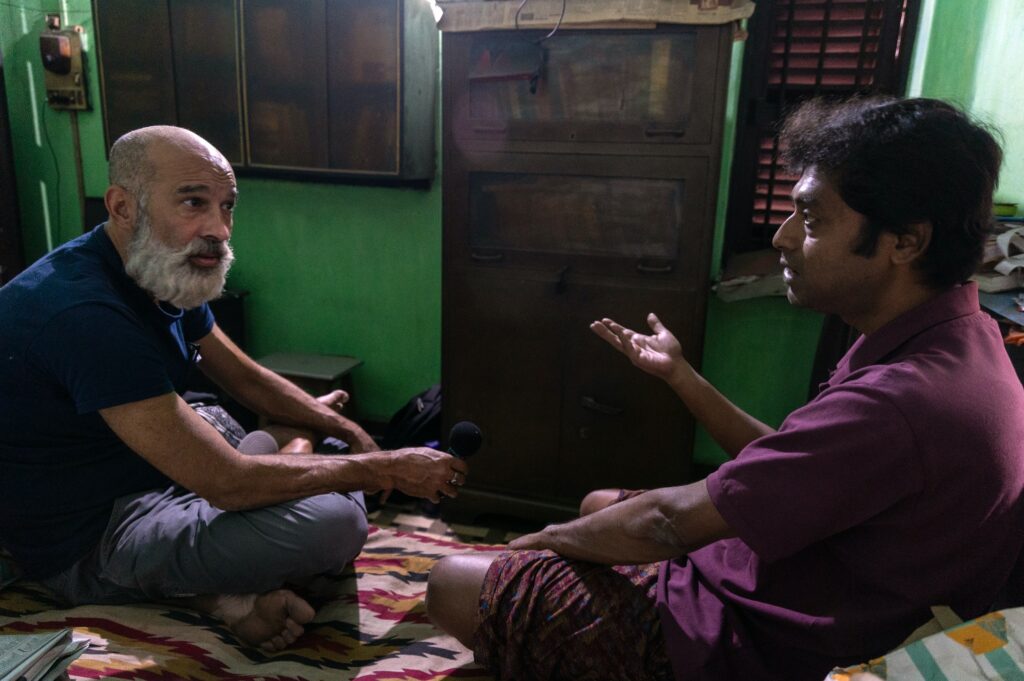
Janam Mukherjee was drawn to oral history by his father, specifically what he did not know about the man whom he describes as simultaneously very loving and kind, and very wounded.
Mukherjee’s father was born in West Bengal during a time of great political upheaval, including sectarian violence and famines aggravated by British colonial forces. He didn’t speak of this time in his life – the period before immigrating to the United States – much to his children, which left his son with a lot of questions as to his father and, by extension, he was.
“In wanting to know myself, the old Greek dictum, and kind of understanding radical individuality as the way to know thyself…at some point I realized that that was limited by the extent of my person and myself, and that is influenced by my father and my mother and my grandparents,” says Mukherjee.
For Mukherjee, reconnecting with his family still in Bengal and capturing their stories became the path to knowing himself. Along the way, he developed his practice as an oral historian, becoming an author and professor who now lectures on oral history at Toronto Metropolitan University.
The centring of the self is not an uncommon practice in oral history, an expansive field within historical research that relies on the memories of firsthand witnesses to history. These stories are gathered through long-form interviews to be preserved in archives or used for additional research studies.
While Mukherjee describes journalism, like traditional western historical practices, as looking at narrative from the top down, oral history seeks to find experts in everyday citizens.
“So much has been written about the so-called working class from the top down, so that instinct of oral historians to reorient historical analysis is true and the inclusion of the voices of working people makes perfect sense and produced a lot of unexpected understanding of things like class consciousness,” says Mukherjee.
The overreliance on experts to the detriment of people with lived experience and community members has plagued journalism, especially in crime reporting. According to Media Smarts, the dependence on police when reporting on crime or legal issues feeds into a multi-billion-dollar public relations industry. The dependence on the police and other powerful institutions also risks replicating the racism and discriminatory practices embedded in said organizations.
Paul Thompson is often considered a pioneer of modern oral historian practices. Thompson was a labour historian who saw an issue with how workers were written about – from the top down – by British academics. Thompson’s tome, The Edwardians, was seminal in its valourizing of the working class, as told directly by the underclasses who worked in Edwardian Britain.
Oral history has been for the preservation of the stories of women, workers, and other marginalized peoples – groups whose access to formal education and means of sharing their stories have all too frequently been restricted.
What’s more is that for many non-Western European cultures, oral history has been the de facto model of presenting their folklore, spirituality, and history. Sarah Nickel, a member of the Tk’emlúps te Secwépemc Nation, is a professor at the University of Alberta who specializes in Indigenous politics and history speaks to this model.
“Many different Indigenous cultures have stories that are gendered too,” says Nickel. “There are the stories that are in the male-dominated
domain for them to share… There are the stories in the women’s domain for them to share. Women have always shared stories, they’ve always taken on that responsibility.”
While nuanced news analysis is fading in favour of the 24-hour news cycle, oral histories are also meant to be analyzed through a critical lens as part of its association with academia. This means oral historians may be more attuned to how their interviewees, or “authors” as they’re sometimes referred to, internalize oppression.
“What I found for Indigenous women in particular is sometimes the trigger point is their children,” says Nickel. “Talking to them about how, ‘Your children want to hear this, your grandchildren want to hear this.’ Sometimes they’re in the room saying, ‘What about this? And what about that?’ And only then are they sharing more in-depth and talking about themselves and certainly that has a cultural element to it.”
Nickel also understands the importance of eliminating the objective self in oral history, especially when it comes to work in Indigenous communities.
“This is where ethics really comes in. That talking to, making a relationship first, even if they’re someone you don’t know, making that connection, making sure they’re comfortable, building that in before an interview and then being really clear that you understand the baggage that comes along with this work,” says Nickel.
The founder of Egypt Migrations, an archival organization that collects the stories of Egyptian diaspora members, Michael Akladios, is also cognizant of how he uses sources’ voices. For him, this means avoiding exploitative practices and allowing interviewees to lead conversations.
“We are careful not to mine people’s voices for information as an object of study, but rather as a subject with their own oppositionalities and intersectional experiences,” says Akladios.
The fallibility of interviewees is a criticism targeted at oral history, but Akladios has a response to that.
“Memory has both a diachronic and synchronic dimension,” says Akladios. “People actually remember with a lot more care than we give them credit for, and those events do get filtered over time by everything that has transpired since, however that’s our job to understand them, to appreciate their subjectivities.”
All these oral history practices could prove useful to journalists: the recognition of the subjective self, doing interviews with community members over arbitrary experts, and allowing sources to lead conversations.
Journalism’s current funding model, though, is not conducive to this when compared to oral history which is sustained by academia and community-based non-profits like Egypt Migrations.
“Oral historians don’t look for scoops,” says Mukherjee. “There’s no oral history scoop that you can be the first one to get at and know and gather that information.”