
50 years of my family’s history was told in The Packet & Times. Now that it’s gone, who will share our stories?
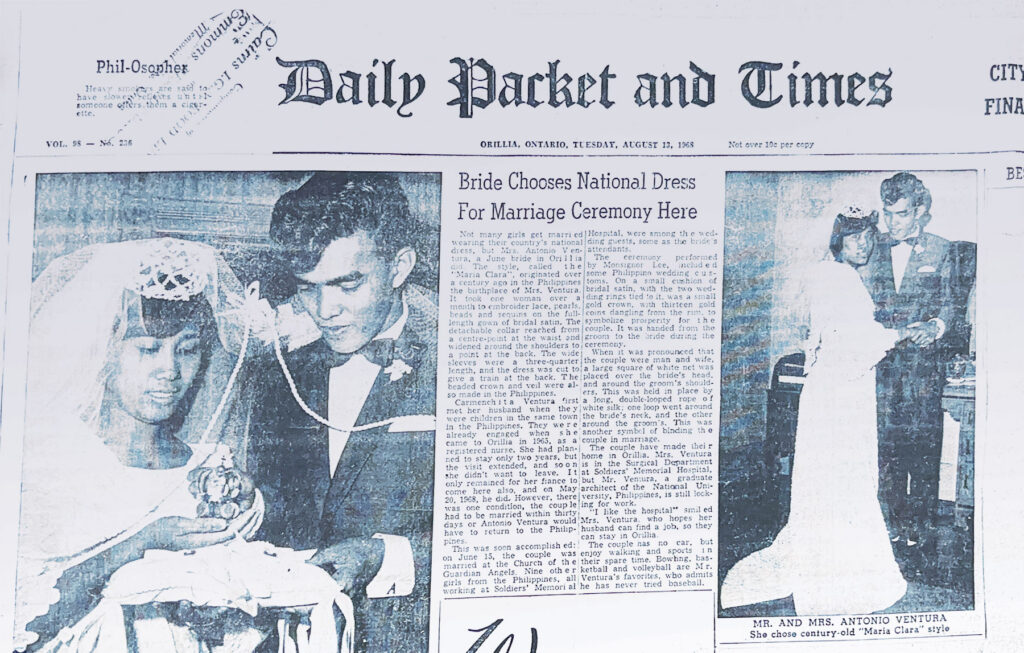
I grew up in Orillia, a city with a population of over 30,000 about 150 kilometres north of Toronto. My grandmother, Carmenchita “Chit” Ventura is why we ended up there.
After finishing her degree at the University of Santo Tomas in Manila, Philippines, Chit set her sights on Canada to find employment. The year was 1965. After a 24-hour journey from Manila to Toronto, she took the bus to Orillia. Here, she worked as a nurse in the surgical department at Orillia Soldiers’ Memorial Hospital.
She arrived in Canada on her own. Her fiancé, Antonio “Tony” Ventura stayed in Manila and continued to work as an architect.
My family’s story can be found in the archives of Orillia’s The Packet & Times.
Chit lived alone in Orillia for three years and Tony joined her in 1968. When my grandparents got married at Guardian Angels Parish on June 15, 1968, the Packet ran a story and published the photos of my grandparents. In one photo they are performing a Catholic wedding tradition common in the Philippines, Las Arras, where the groom gives the bride a gold crown and coins. The other photo highlights Chit’s dress, a María Clara–style dress.
Over the years as the Ventura family grew, you could find updates about our lives in the paper. Tony was deeply involved at the community level. If he or anyone he knew was printed in the pages of the Packet, you could guarantee he had a copy.
In the basement of my grandparents’ house — which Tony designed — you’ll find stacks of Sunday bulletins from Guardian Angels Parish, family photobooks, bowling trophies, and of course, aging issues of the Packet.
“I bet [Tony] still misses [the Packet],” Chit says as we sit at the kitchen island in the home he designed. “[Because] on the computer he’ll read everything. He’s just used to having something,” she says.
For 147 years, the Packet published weekly coverage of local news, politics, sports, obituaries, and more. On November 27, 2017, it ceased publishing, ending a century and a half of its role as Orillia’s paper of record.
The Packet was among 36 newspapers that closed in a mega newspaper swap between Torstar Corp. and Postmedia Network Canada Corp. that mostly affected southern Ontario. Over four community newspapers in the Simcoe County area also closed in this swap. This put approximately 290 employees out of work.
I remember the first time the Packet didn’t hit our doorstep. I was 13, and I didn’t think much of the missing paper at the time.
Though as I got older, I started to realize a gap in how I remembered my family’s history. I got used to the feeling of pride when one of my family’s faces appeared in the Packet. After a while, I started to wonder where I could ever find those memories again.
After combing through digital archives, I found that my history was stitched together from site to site, from newspaper clippings to the scans on my mother’s computer. Some of the Packet is archived online through the Toronto Public Library, but only from 2000–2006. I combed through Simcoe.com, a site owned by the Metroland Media Group that was created to serve the communities that once had Simcoe County weekly newspapers.
After digging, I was able to find pieces of my family’s archive online. Though it was not as historically robust as the site implied. According to the site, 26,000 files were uploaded to the website over one week in April 2018. The archives included once-thriving titles: Alliston Herald, Barrie Advance, Bradford Topic, Collingwood Connection, Innisfil Journal, Midland Mirror, Orillia Today, Stayner/Wasaga Sun, Barrie Examiner, Bradford Times, Collingwood Enterprise Bulletin, and the Packet.
Using keyword searches and hyper-specific dates, I was able to find articles from the Packet, mainly from 2013–2017.
Going through these scattered archives, I found photos I had never seen before.
May 6, 2015: “Team wins regional crown for second year in a row” from the Packet. There’s my grandfather, Tony, alongside his friends from Guardian Angels Parish winning yet another bowling trophy.
Living in a city like Orillia, locals get used to relying on the same things. Running into friends at a restaurant downtown, taking the same commute, the newspaper arriving at the door. Similarly, locals will rely on news organizations to keep them up-to-date on city happenings, municipal government updates, last night’s score, and wedding announcements. But in a city with no newspapers to distribute and a large senior population, this information delivery can get caught up in a game of telephone.
Seniors (ages 65 and older) made up 26 percent of Orillia residents according to the most recently available census data from 2021. According to a 2024 release by Age Friendly Orillia on the digital news site, OrilliaMatters, the city’s senior population is projected to grow to 40 percent by 2040. In Orillia, citizens had a few reliable sources to get their fix of local news and municipal updates, they had the Packet until 2017 and Orillia Today, which ceased print operations in 2023 and became integrated into Simcoe.com.
Jay Fallis, Orillia city councillor in Ward 3 and former Packet columnist, noticed how the lack of print media releases was leading to confusion in locals. In January, the Ontario government introduced a new blue box recycling program. Fallis was finding there was general confusion around the new parameters of the new Ontario recycling program.
“What’s happened, who’s now responsible for recycling, who do we direct all these concerns and problems to?” Fallis recalls hearing online and in conversation with community members.“That’s certainly a situation where if we had had the print media we would have solved that issue right off the bat,” he says. A lot of the confusion could have been addressed faster with the tool of a community paper.
Fallis found the use of print media and the method of door-to-door distribution to be most effective in delivering information to Orillians. So, the lack of community newspapers has thrown a wrench into how some Orillians access news. “This is one example where it would have been very prevalent in Orillia Today or in the Packet centrefold,” says Fallis. To him, the newspaper was one of the most prevalent ways the municipality was able to communicate with the community at a mass level. Without the newspaper being sent to doorsteps, Fallis was noticing an increase in confusion surrounding the changes to the recycling program. “[Seniors will be] unaware that certain city matters are happening — that’s very common,” he says.
The centrefold of a newspaper was one of the most efficient ways to deliver information to the city. The full page could cover messages from the city that would be delivered regularly to people. Without it, a segment of the population will be left without that information.
Without a local paper, communication from the municipal government can get lost in inboxes and online press releases that some people could have trouble accessing. “There’s always going to be that gap that print media is no longer there and it’s difficult to find that replacement,” he says.
Social media has played a large role in how news is shared, though after the passing of the Online News Act (Bill C-18) in June 2023, the ability to share news has grown more difficult. In August 2023, Meta announced that the company would permanently be ending news availability on all its platforms including Facebook and Instagram. This meant that news content would be blocked for Canadians. This has impacted link sharing via the platforms’ messaging channels and also blocked Canadian devices from viewing any news organizations on the platforms. This change put up another barrier to senior news access and distribution.
Macaulee Cassaday is the cofounder and program director of Cyber-Seniors, a nonprofit organization aimed to promote digital literacy and intergenerational connections. “We started the nonprofit, and at first it looked like we were creating training materials so that other people in their communities could start their own Cyber-Seniors programs, go into community spaces, and bring young people to teach older adults.” Cassaday founded Cyber-Seniors in 2015 alongside their sister and has seen a shift in what seniors are looking to learn.
“There’s always going to be that gap that print media is no longer there and it’s difficult to find that replacement.”
Cassaday and their sister were inspired to start the organization after witnessing how the internet transformed their grandparents’ lives. After learning basic internet skills like using Skype, email, and Facebook, their grandparents were able to stay connected to the rest of their family.
When asked about how seniors reacted to the Meta ban, Cassaday recalled seniors not really noticing the lack of news on Facebook. To some seniors, news sharing on social media essentially disappeared that day; “It’s not even like [seniors] would know that they want to be doing that because it’s just not there,” they said.
Fallis has been vocal in committee meetings and staff conversations about the need for print mailers to community members. Though due to differences in budgeting priorities, the municipality has not opted to send out physical fliers unless essential. But with a landscape as large as the internet, information can be easily missed.
In Orillia, residents can source local news from one place, online news site OrilliaMatters. But those struggling with digital literacy may find it difficult to adapt to not only technology but relearning how to consume news. Cassaday has had a range of experiences and comfort levels with technology through Cyber-Seniors’ drop-in tech help programming. Cyber-Seniors hosts a variety of digital older adult programming and runs daily tech sessions over Zoom to answer technology-related questions from seniors. “A part of our thing is also not just showing people how to use technology, but giving them meaningful ways to use it,” they say.
Cassaday says the format of news delivery is a barrier for many seniors. “The main emotion that I feel is expressed, is that feeling of overwhelm, because when we’re talking about switching from print to digital, it’s not just that, it’s a new way of accessing in terms of the actual medium of accessing that information. It’s also pace, right?” says Cassaday.
From 2022–2024, the Canadian Coalition for Seniors’ Mental Health (CCSMH) conducted a research project on social isolation and loneliness among Canadian seniors. In this project, CCSMH conducted two national surveys. In the surveys, conducted in 2023, older adults and health and social service professionals were asked about their knowledge and attitude towards social isolation and loneliness. In the survey of health-care professionals, they were asked to identify challenges in reaching senior populations regarding resources and programming to mitigate social isolation and loneliness.
Based on their experience with seniors, health and social service providers identified digital literacy as a significant personal barrier. One health care professional noted observing that their senior clients have preferred to not communicate through technology. “Many senior clients do not prefer communicating through technology (e.g. Zoom). In addition, access to (and ability to use) technology is also a major barrier,” said an anonymous health care professional.
In the national survey of seniors, concerns around technology literacy were highlighted. The survey takeaways recommend that health care professionals and providers offer a range of technology and non-technology options for appointments and services. They suggested providing and connecting seniors to services that offer digital literacy training but to also not assume all seniors are tech illiterate.
After the Packet’s closure, the community felt the large loss in local news coverage. Dave Dawson was one of the last at the Packet in a freelance editorial capacity. The closure in 2017 came as a shock to the entire community, he says. Dawson says he discovered he had lost his job over X (formerly Twitter).
Within the first few months of the Packet’s closure, Dawson worked with Village Media to launch the website OrilliaMatters. The site launched in January 2018. Dawson hopes to keep the memory of the Packet alive and frequently speaks on the newspaper’s history and significance to the community. At a Zoom event hosted by the Orillia Museum of Art and History, he spoke about the legacy of the Packet. As the years pass on, Dawson finds it important to remember and educate people about the paper’s critical contributions.
He was at a public event in Orillia some time ago when a stranger approached him. Dawson began explaining his journey to Orillia Matters to the stranger: “Naturally I told her with pride that I’d started at the Packet where I learned the ropes and began to hone my craft,” recalls Dawson.
“She had a bit of a blank look on her face and she asked, ‘What is the Packet?’ Her question was a bit of a punch to the gut. In my world, the Packet is like a touchstone, an important part of my history, and the heritage of this strange and wonderful place called Orillia.”
The launch of the site was celebrated by the community, but the issue of senior access still persisted. Even with a large shift to online news, the gaps in digital literacy still exist in these communities. With the sudden closure of the community newspaper, older adults were left to adapt quickly — and learning a new skill doesn’t happen in a day or month, or even a year.
Marc Edge is a journalist and media educator at University Canada West. He studies journalism history and media economics. His book The Postmedia Effect: How Vulture Capitalism is Wrecking Our News, covers the changing Canadian news industry and media landscape. To illustrate his point, he analyzes the asset swap between Postmedia and Torstar that resulted in the loss of approximately 290 jobs and closed 36 local newspapers
Edge feels the format, and therefore, the experience of reading a physical newspaper is irreplaceable. “Our media are changing, from analog to digital and print to digital. Newspaper reading is actually highly addictive,” he says. According to a 2025 report from News Media Canada, “more than half (54%) the adult population reads newspapers in traditional formats: either in print or an e-edition (a digital version of the printed format).”
Edge cites Aurora Wallace’s book Newspapers and the Making of Modern America: A History, as key research in understanding the importance of local newspaper format. “The local paper can and does things that no other media has yet been able to achieve,” says Edge, quoting Wallace’s research. “They keep readers informed, but they are also the engine behind the construction and maintenance of strong communities, locally and nationally. When they falter, we must ask what else might suffer as a result?”
Senator Andrew Cardozo issued a report calling on the federal government in March 2025 titled CBC/Radio-Canada: An Essential Service. In the report Cardozo — who is a former adjunct professor in journalism and communication — made a series of recommendations and outlined his vision for CBC/Radio-Canada. The senator’s fourth key recommendation for the federal government was to renew focus on local news across the country to ensure that broadcasters can better serve the public where they live. The recommendation also included “radically reducing” the budget of national CBC bureaus (Toronto, Montreal, and Ottawa) and redistributing resources across Canada to provide “high-quality content across the country,” writes Cardozo in the report.
In the report, he noted the closure of private local media outlets and urged CBC/Radio-Canada to prioritize local news coverage.
“Despite being highly trusted by Canadians, local news outlets are increasingly closing, leaving a void that is not easily filled,” Cardozo writes. Since Cardozo’s proposal, CBC has pledged to open 11 new local CBC News bureaus across Canada. This change will increase CBC’s coverage footprint from 66 to 77 bureaus and stations across the country, especially increasing service in the western part of the country.
Orillia illustrates this problem as a microcosm, particularly in the isolation experienced by seniors as audiences have shifted their news consumption practices. The existence of local news coverage is only the first piece in keeping senior communities informed. The second half is manufacturing how to promote and simplify access. Fallis ran for Orillia city council in 2018 and he then was re-elected again in 2022. During Fallis’ first term, he worked with Information Orillia to design a news line for seniors that could be accessed through the phones.
“We had volunteers reading out the news each day,” says Fallis. He recalls about 10 volunteers assisting in managing the calls. Though one of the biggest challenges in keeping these programs running was maintaining volunteers. “There was a point where unfortunately, we weren’t able to keep the strong list of volunteers and so slowly it faded.” The news line ran for about two years.
Fallis highlighted community programs in Orillia he has found filling the gaps for seniors in the area. Age Friendly Orillia and Information Orillia have frequent programming running to keep seniors engaged in the community.
Helping Hands Orillia runs the Orillia Seniors Line. Seniors are able to call in, press two and hear the daily headlines.
Community sits and exists in the digisphere and on the cobblestones of Mississauga Street East. In a post-Packet Orillia, Tony and Chit have found new ways to stay up-to-date. Though, most commonly they’ll hear the news from one of their children, grandchildren, siblings, or friends at their church. When I go over to their house and ask about the Packet, Tony brings me downstairs to his office. I kneel on the red fuzzy carpet as he tells me about every time his face has been seen in newsprint.
There’s a photo of him when he first learned how to play golf and one of him helping at the high school free-throw fundraiser. But his favourite hangs on the wooden paneling in the basement, in the spare room.
A framed cut out of their wedding announcement in the Packet.
He tells me long stories of his university days, his first flight to Canada, and when he used to volunteer with the local food bank delivering loaves of bread. My family started in the paper and I’m forever grateful I’ll have my history stored in ink.
Tony loves to pull from his Packet archives; if you ask he’ll grab you a stack.
About the author
