
Efforts to integrate Indigenous history and perspectives into journalism education are prompting deeper questions about whose knowledge is centred, how stories are told, and what responsible reporting should look like.
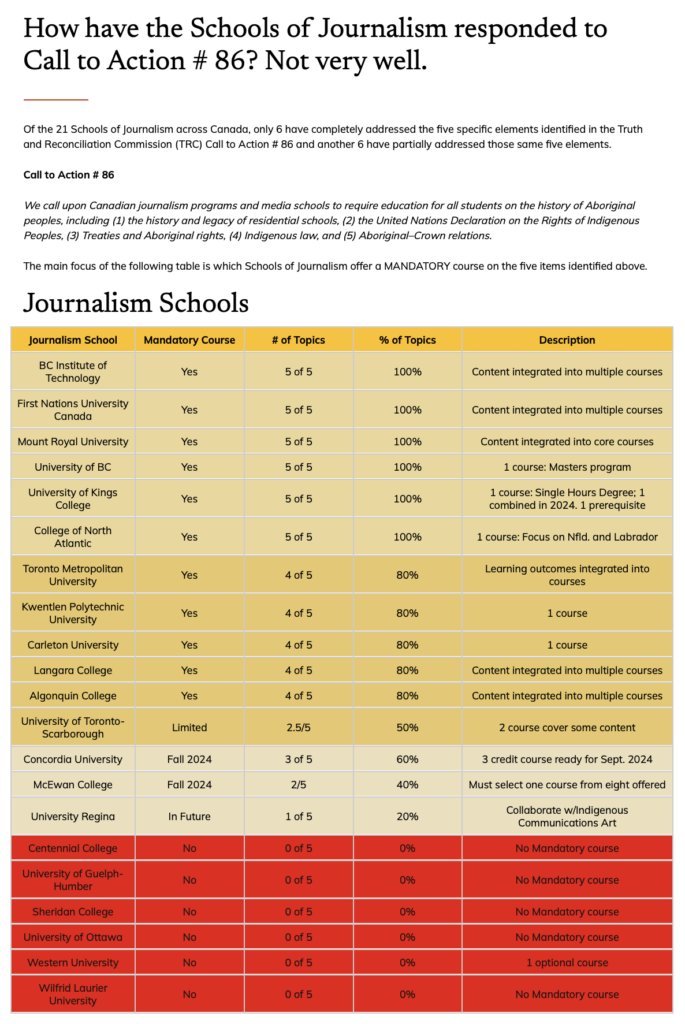
More than a decade after the Truth and Reconciliation Commission of Canada called on journalism schools to mandate education on Indigenous history and rights, most programs have yet to fully implement the recommendation. Only six of more than 20 active journalism schools nationwide have completely addressed the elements outlined in Call to Action #86.
Data and research from Indigenous Watchdog highlight a significant gap in how future journalists are trained to report on Indigenous communities. The organization, which monitors progress on all 94 Calls to Action, found 10 journalism programs have addressed 60 percent or less of the required content.
Call to Action #86 specifically urges journalism programs to teach students about the history of Indigenous peoples, including the legacy of residential schools, the United Nations Declaration on the Rights of Indigenous Peoples, treaties and rights, Indigenous law, and Indigenous-Crown relations. But progress has been uneven with many schools incorporating these topics into their curricula only partially — or not at all.
The issue has also surfaced at Toronto Metropolitan University (TMU), where the School of Journalism implemented a pause on students interviewing Indigenous staff, students, and campus organizations until fall 2026. The decision followed concerns from Indigenous community members about the volume of interview requests and the repeated demands on their time and expertise — a dynamic that has caused harm and reflects gaps in Indigenous education and extractive reporting practices within the program.
Those concerns were part of a broader discussion at a live Media Indigena roundtable recording hosted by Cree journalist Rick Harp at TMU on March 11, 2026. The event was organized by the Yellowhead Institute and Saagajiwe in partnership with TMU’s School of Journalism as part of its internal examination of its commitment to Call to Action #86 and the university’s “Standing Strong Recommendation 9,” which calls for stronger mandatory learning on Indigenous history and Indigenous-colonial relations across all programs, beginning with first-year journalism courses.
The discussion extended beyond TMU, examining what meaningful change in journalism education could look like, from integrating Indigenous knowledge into curricula to rethinking how journalism students build relationships with Indigenous communities.
“Media has very much created boundaries for how we tell stories,” says Candis Callison, a Tahltan First Nation environmental journalist and professor at the University of British Columbia School of Public Policy and Global Affairs. She noted journalism education often reinforces the status quo by limiting forms of storytelling, pointing to the inverted pyramid, which is one of the first reporting structures taught in journalism school and newsrooms.
These storytelling conventions are not neutral. Canadian journalism developed within a settler-colonial system that historically marginalized Indigenous voices and reinforced stereotypes in coverage. The publisher of Indigenous Watchdog, Douglas Sinclair, criticized this pattern by identifying the “Three Ds,” referring to media coverage that repeatedly frames Indigenous peoples as “dancing, drunk, or drumming.” In Decolonizing Journalism, a novel by Anishinaabe journalist Duncan McCue, he adds a fourth recurring frame: stories that focus only on Indigenous peoples in death.
Harp noted many reporting practices still reflect these harmful frameworks, as journalism schools still operate within the “continuity of colonial origins” — a system that has long produced misrepresentation and underrepresentation of Indigenous communities in the media.
Indigenous journalists and researchers like Connie Walker have documented how these structural patterns shape coverage of Indigenous communities. A member of the Okanese First Nation and associate professor of journalism at TMU, Walker’s investigative reporting and award-winning podcasts, Stolen and Missing and Murdered, examine violence against Indigenous women and the lasting impacts of residential schools. Her work not only exposes gaps in mainstream coverage but also models a form of journalism that centres Indigenous voices, historical context, and community accountability.
Walker is now bringing her lived experience into the classroom through the course she teaches called Reporting on Indigenous Issues. At the panel, Walker — who began teaching at TMU in September 2025 — says she was struck by how quickly students recognized the importance of the subject matter, reflecting a generation that has grown up with more exposure to Indigenous history than many journalists before them. For Walker, that shift offers hope that journalism education can play a role in changing how Indigenous stories are reported.
In a separate interview, Trina Roache, video journalist and assistant professor at the University of King’s College School of Journalism, emphasized the role students can play in driving that change. Roache, a member of Glooscap First Nation in unceded Mi’kmaw territory, pointed to a June 2020 open letter in which students called on the school to develop an action plan to improve diversity and inclusion across its curriculum, faculty, and student body in line with the TRC’s Calls to Action. The letter prompted swift changes, including the introduction of mandatory courses on the histories of Black and Indigenous communities in Nova Scotia.
But Roache noted that part of the challenge for journalism schools in implementing mandatory Indigenous education is the slow pace of institutional change in academia and a shortage of Indigenous journalists available to teach the courses, particularly at schools with less diverse faculties.
At the same time, Harp cautioned that conversations about resolution in journalism education can sometimes become vague.
“Too often, I think post-secondary institutions will use words like ‘colonize’ or ‘Indiginize’ as these kind of catch-all terms,” says Harp.
He argued those terms can mean very different things depending on who is using them, and that universities need to be more clear about what real change would look like in journalism education. Drawing on Callison’s book Reckoning: Journalism’s Limits and Possibilities, Harp highlighted three approaches she identifies for amending journalism: “Repair,” “reform,” or “transform.” He says the distinction challenges journalism schools to consider whether they are simply adjusting existing practices or fundamentally rethinking how the profession operates and whose knowledge it centres.
“You can’t Indigenize without Indigenous people,” says Callison. Research in journalism education shows that alternative models — including reconciliation and collaborative approaches that centre Indigenous perspectives — not only broaden the range of stories told, but also encourage more relational, accountable reporting practices. These approaches help align programs with the TRC’s Call to Action #86 and may foster long-term, reciprocal engagement with Indigenous communities, moving beyond extractive, episodic reporting.
“There’s such a tension between wanting students to engage with important issues, wanting students to really understand best practices, to be able to just be in relation with other Indigenous students, faculty, staff, or community members,” says Roache. “Those relationships are really, really important,” she adds, noting that there is a difference between engaging with communities solely for an assignment versus cultivating ongoing, respectful connections.
At the University of King’s College, the Mawaknutma’tnej, a circle of Mi’kmaq community members and leaders, offers students, faculty, and staff the opportunity to engage directly with the community. The circle meets about four times in the academic year to provide feedback on projects and initiatives, allowing participants to bring their research and ideas before collaborating with knowledge holders to ensure approaches are respectful and culturally informed. Roache explained that the process is not simply about asking the community for answers, but about finding balance.
This approach reflects the intent of Call to Action #86, and mirrors the themes Callison discussed during the panel, highlighting the importance of integrating place-orientation and self-location into storytelling to help reconcile journalism education.
“I think the sweetest spot for disrupting the status quo is to be place-oriented. Understanding your obligations to the lands and waters where you are, also connects you to the people who have been here since time immemorial, and who know this land, and who can teach you things about it. To me, that’s one of the most important pieces of integrating it into education,” says Callison.
Understanding one’s obligations to the land and communities where reporting occurs helps students build deeper, more informed relationships. The panelists indicated that programs adopting these approaches can effectively actualize Call to Action #86 by providing students with sustained engagement opportunities, centring Indigenous guidance in reporting, and encouraging reflective, accountable practices.
Embedding these principles into journalism curricula moves beyond tokenistic inclusion, equipping students to cover Indigenous communities ethically, collaboratively, and in ways that honour historical, legal, and cultural contexts.
Roache also invoked Anishinaabe journalist Tanya Talaga, who wrote in a Toronto Star op-ed that Indigenous history is not an elective, but a fundamental, often painful, shared history that shapes the present. Making Indigenous perspectives central, not optional, in journalism education is essential.
“If you don’t have the professionalism…being trained or educated on Indigenous issues, then it’s just going to perpetuate the problems that First Nations are in a way going to be experiencing,” says Sinclair.
About the author
