
Journalists are turning to gamification as an engagement tool, but differing approaches highlight how the strategy is vulnerable to exploitation–and why intention matters.
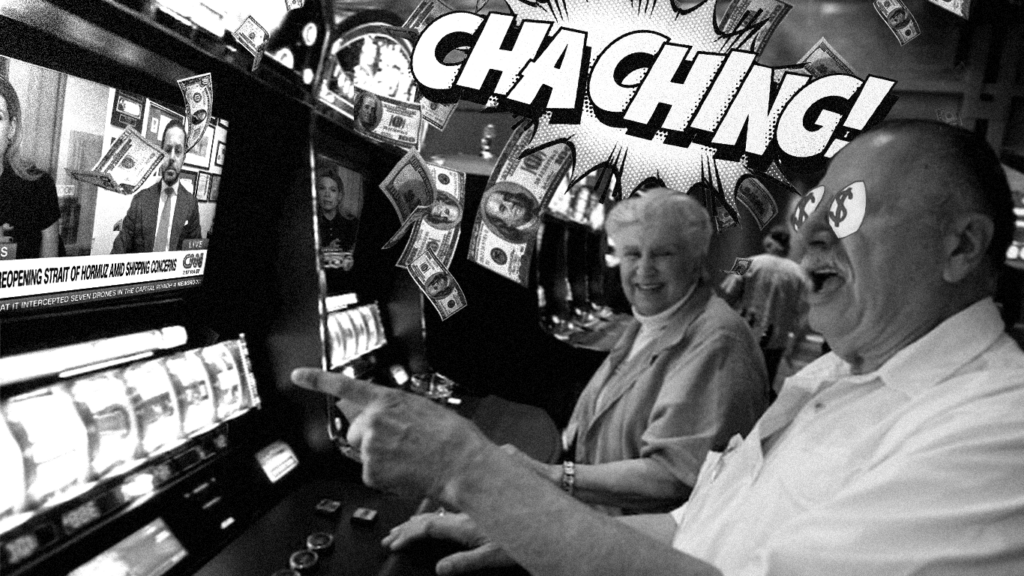
Bob* watches with glee as smoke rises into the sky, billowing out over the cityscape in a majestic mushroom cloud. Flames lick up concrete, earth, stone, steel, shattering glass panels and lining the sidewalks with ash. A deafening boom reverberates through the wreckage when a familiar two-tone siren cuts through:
“DING! DING! DING!”
Hooting and hollering, Bob shoots up from the worn-out La-Z-Boy in his basement in triumph. Gold dollar signs flash across his phone as he clicks the TV off, nuclear war forgotten.
Now, Bob-the-basement-dweller might be fictional, but gambling on catastrophic news is not. In December 2025, Kalshi, a ‘web-based prediction market platform’ (see: online betting tool), announced it was partnering with CNN, “becoming the network’s official prediction markets partner.” According to the press release, the collaboration allows users to “trade on real-world events to predict the outcomes of elections, weather, cultural moments, and more.”
But if by “cultural moments,” you mean life-and-death issues, one betting market has encouraged people to gamble on whether Israel would bomb Gaza. And the state of Michigan, represented by Attorney General Dana Nessel, is suing the parent company of Kalshi for allegedly offering online betting services without proper authorization.
“In October 2024, Kalshi expanded into political event contracts…these political contracts were presented as opportunities to profit from ‘civic knowledge,’” writes Nessel. “In reality, Kalshi was designed from the outset to appeal to mass market speculation.”
Gamifying the news – or, in this case, the ‘casinofication’ of news – has prompted ethical concerns from politicians, lawmakers, academics and journalists alike. Beyond grossly commodifying human suffering, there is a well-founded fear that news gamification will be used to exploit people rather than educate them.
“One of the things we found is that gamification was often viewed as being quite exploitive of audiences, and gimmicky in the sense of trying to find ways to gather audience attention, audience clicks, but not for meaningful engagement,” says Gregory Perreault, a media literacy and analytics professor at the University of South Florida, whose research has analyzed gamification in the news. “It was just to figure out ways to sort of profit off of [the audience] online.”
There are also systemic issues at play. If there is a profit incentive for viewers to bet on the likelihood of certain events and for reporters to relay those odds, this could exacerbate pre-existing biases and stereotypes. And without proper representation in the newsroom, the risk of misrepresentation is amplified.
What’s problematic, Perreault adds, is that the journalists covering those events would then seem to have some stake in their outcome. “…it leads to a very sort of dystopian vision of what news could be if it wanted to be profitable,” he says.
Kalshi’s prediction market is aimed at getting people to keep coming back — and keep spending more money — rather than rebuilding trust among alienated audiences. A study of media consumption in the United States found news avoidance tends to be more common among young people and lower socioeconomic classes. And while research shows societal disparities put people at greater risk of developing a gambling problem, part of CNN’s motivation to adapt this tool may well have been to expand its reach.
“How many news organizations, desperate for cash and for clicks, will move in a similar direction?” writes Danny Funt for The New Yorker.
As outlets lose distribution to major platforms, pressure to capture audience attention is especially acute.
In Canada, where Meta has blocked news content, many media organizations are competing with social media for people’s attention, whether for the sake of good journalism (accuracy, transparency, democratic participation, etc.) or advertising dollars.
In this environment, the odds of journalism adopting gamified strategies to increase engagement is growing.
“[Journalists] are trying to figure out basically, is there a way around these platforms,” mulls Perreault.
Given the risk that people’s lived realities will be commodified in the process, he says, the challenge is designing a digital intervention that engages audiences in a meaningful way. In other words, how can news gamification be used to strengthen core journalistic values rather than dismantle them?
It’s the kind of work Jack Brewster is doing. Before founding Newsreel, Brewster was working as a reporter at mainstream news companies including Forbes and Time Magazine. But he was “really frustrated” by how hard it was becoming for journalism to connect with the younger generation.
“I was seeing stats that were showing me that people were reading my articles for an average of 2.1 seconds, and that was kind of the industry norm, meaning that people would click and look at the headline and then bounce out,” Brewster says.
That frustration drew him to design and develop Newsreel, an app that focuses on driving engagement through swipeable news stories, along with quizzes, and polls about the news. Users can also add their friends to compare scores and share ‘news streaks.’ The app leverages a combination of gamification and social media behaviours (such as swiping and scrolling in hopes of drawing people away from socials, where mis and disinformation are flooding people’s feeds without any real guardrails.
As of 2025, Meta has stopped using independent fact-checkers on Instagram and Facebook. And in the months leading up to the Federal election, researchers found over a quarter of Canadians believed they had been exposed to fake political content on social media.
As a Fulbright scholar in Germany, Brewster was also researching how the internet and digital tools were changing how people spend their time.
“I mean, when you start to look into this, it’s hard not to feel sick to your stomach,” says Brewster. “…all this time that we’re wasting away on these platforms, and how they’re built to addict you, I felt a visceral reaction to that.”
When you take a gambling scheme like Kalshi, or even the basement-dweller trope sometimes attached to video game players, the exploitative part of gamification is also its addictive potential. Like any digital technology, intent matters. Journalism designed to profit from people’s lack of self control is no better than any other unscrupulous consumer ploy (see: problem betting).
“Technology has always been used for good or for bad, and so as a journalist, I’ve sort of taken the role of like, ‘Okay, accept the reality that we’re in,’” says Brewster. “…let’s use it as a way to accelerate the spread of higher quality information, higher quality reporting, and just higher quality critical thinking.”
Other journalists have also experimented with gamification to combat disinformation. For example, The Bad News game, developed by a Dutch media collective, aims to build resistance against online misinformation by getting players to act as ‘fake news producers.’ The goal is to build an empire of untruth–while keeping your followers believing. It’s based on inoculation theory, which suggests feeding someone fake news they know to be false in small doses can build their resistance against the real thing, like a vaccine.
Multiple studies have found the game does, in fact, improve players’ ability to identify false or misleading information.
But media organizations must be aware of the motivations — financial, political, social, and ideological — behind any intervention. Because when you factor in their exploitative potential, much is at stake. Especially considering there has been less focus on gamification’s adverse effects.
As researchers Maria I. Klouvidaki, Nikos Antonopoulos, Ioanna Kostarella and Stelios Tsafarakis conclude, “While gamification promises to revitalize digital journalism, it also raises critical questions about its ethical implementation, impact on editorial integrity, and potential for audience segmentation or exclusion.”
Questions we must keep in mind as the attention economy shows no sign of slowing down — and Kalshi-addicted ‘Bobs’ wait eagerly for their next disaster payday.
“If we want people to engage, it’s a matter of, how do we create some sort of gamified intervention that is still meaningful, that does still get people the information they need,” says Perreault.
