Journalists like Amber Bracken act as the public’s eyes at sites of Indigenous land defence. She’s now in B.C. Supreme Court fighting to maintain that right.
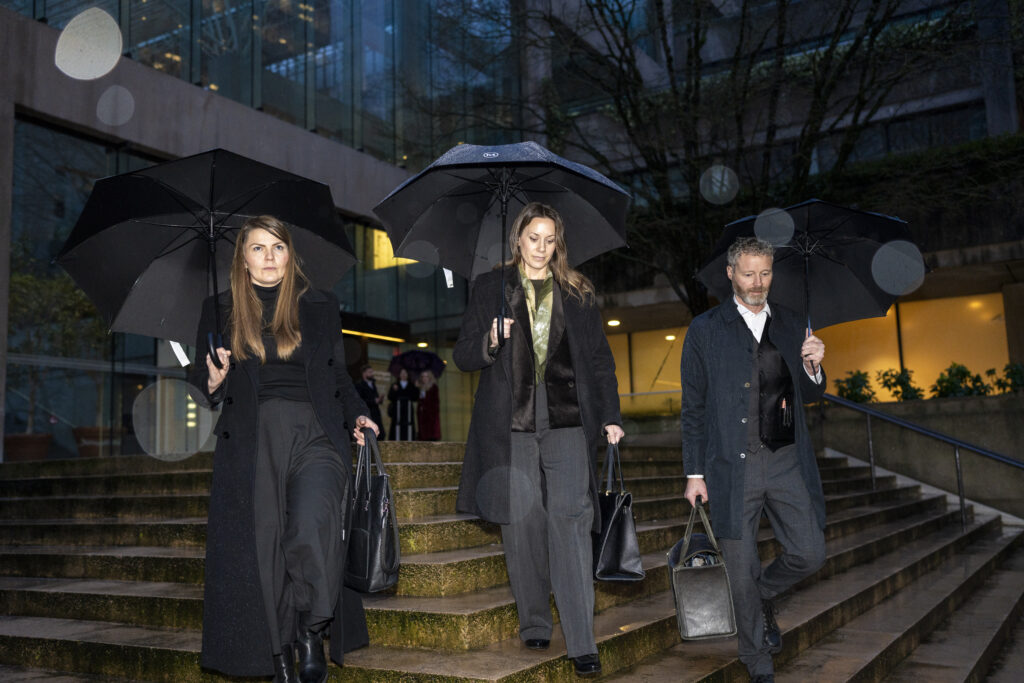
When The Narwhal assigned photojournalist Amber Bracken to go to Wet’suwet’en First Nation, the independent media outlet didn’t expect she would spend four days in jail because of it.
That was in 2021. Now, the Narwhal and Bracken are returning to court next week after a pause in legal proceedings in a landmark legal fight, following the joint lawsuit they filed on February 13, 2023. They argue the RCMP wrongfully arrested and detained Bracken as she was alongside land defenders opposing the construction of a Coastal GasLink (CGL) pipeline on unceded ancestral land, and that police actions breached her and the Narwhal’s Charter right to freedom of expression.
Two questions have been central to this case: Journalists’ rights to report from injunction zones and how they identify themselves in the field. These questions are salient as journalists work in increasingly hostile environments. Journalist Rachel Gilmore recently faced public intimidation following one of her investigations; smear campaigns have silenced journalists reporting on what has been deemed a genocide in Gaza by a UN commission and international genocide scholars; and journalists have been arrested or threatened with arrest for reporting on protests — a pattern particularly observed on sites of Indigenous land defence. That’s why it’s notable that an independent, nonprofit outlet like the Narwhal is going to bat for a freelance journalist.
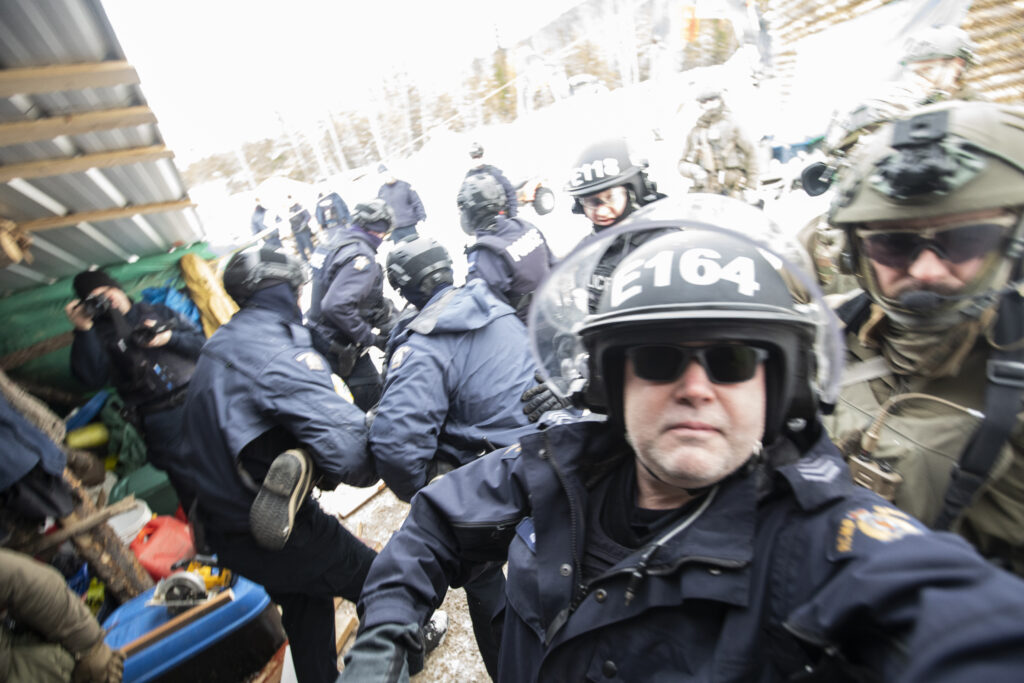
Bracken was alongside land defenders who were occupying a tiny house in an area covered by a court-ordered injunction when RCMP officers began their enforcement. The injunction granted to CGL authorized officers to “arrest and remove” any person physically occupying the area or impeding the pipeline project or access to it. Defence counsel for the Attorney General of Canada, representing the RCMP, has tried to assert that Bracken extended beyond her role as a journalist by remaining in the small structure as the RCMP’s Community-Industry Response Group began its enforcement. One of the Crown lawyers, Craig Cameron, implied Bracken had multiple opportunities to alert the RCMP she was there and ask for permission to remain embedded.
But the day before her arrest, Canadian Association of Journalists president Brent Jolly emailed an open letter to the RCMP informing them that Bracken and other journalists were in Wet’suwet’en territory. The Narwhal also emailed the RCMP to inform them Bracken was there. Both emails were forwarded to the RCMP’s assistant commissioner for B.C., John Brewer. Brewer, who led the RCMP’s 2021 operation, testified he couldn’t remember “when [he] would’ve read them,” and didn’t know Bracken was in the house.
Yet on that cold fall day in 2021, the RCMP arrested and detained Bracken — despite her clearly stating that she was a member of the press at the time of her arrest, despite the press pass draped on the side of her body, and despite the visibility of her professional cameras.
What’s equally frightening is that actions like these could have a chilling effect and discourage journalists from covering Indigenous land defence. Steph Wechsler, the managing editor of J-Source and the Canada Press Freedom Project says that when the “risks are this high and consistent,” it’s discouraging for both independent journalists and workers at more resourced outlets as they try to develop a beat around Indigenous rights, environmental issues, and land defence.
After her release, Bracken says one of the first phone calls she received was from a close Indigenous friend, who asked her: “So, how does it feel to be treated like a native?”
Writing for the Narwhal following the incident, the Edmonton-based photojournalist noted that “most of those arrested that day were treated worse than [she] was — officers cut a medicine bag and ripped cedar regalia from Sleydo’, a hereditary Wing Chief.”
Sleydo’ (Molly Wickham), a Wing Chief of Cas Yikh; Shaylynn Sampson, a Gitxsan woman with Wet’suwet’en family ties; and Teka’tsihasere Corey Jocko, a Kanien’kehá:ka pipeline opponent, were given suspended sentences for breaching the court order CGL was granted.
Indeed, Indigenous land defenders faced an additional oppressive force — racism. According to a Canadian Press article, the police seized recording devices from Sleydo’ and Bracken which captured the officers comparing the Indigenous women to the goblin-looking “orcs” from The Lord of the Rings.
…
In the time following Bracken’s arrest, the Narwhal spoke with news media, photojournalists, freelance reporters, and journalism organizations. Bracken says she’s received supportive messages from independent journalists across the country. And to Carol Linnitt, the cofounder and acting editor in chief of the Narwhal, these conversations were “so on the radar” because this incident was far from isolated.
A bevy of previous incidents demonstrate the challenge of covering land defence movements. Journalists Justin Brake, Jerome Turner, Melissa Cox, and others have also been arrested while trying to report on Indigenous opposition to resource extraction. Documentary filmmaker Michael Toledano was arrested alongside Bracken; he was there producing his film Yintah.
During the #ShutDownCanada Movement in 2020, photojournalist Camilo Ruiz drove North to the 27-kilometre mark on the Morice West Forest Service Road to photograph the Wet’suwet’en land defence.
He met Sleydo’, asked if he could stay, and when she said yes, he donned a high-visibility vest. The next day, Ruiz was in a cabin when the police broke down the door and grabbed him. They took his camera and arrested him, despite identifying him as a media worker.
“In the booking, they wrote down my name, took my ID, and gently handled my camera. They wrote media,” says Ruiz. He says calling himself a photojournalist at the time felt like “stolen valor,” and he more so saw himself as a “guy with a camera.” Given this, he says the defence counsel’s assertion, that perhaps the RCMP couldn’t tell Bracken was media is “preposterous.”
“They know exactly who we are,” he says.
Just months before Bracken’s arrest, the Narwhal was part of a media coalition that took the RCMP to British Columbia’s Supreme Court over its restriction of media access at Fairy Creek in Pacheedaht First Nation — the site of land defence against old-growth logging. Justice Douglas Thompson said in his decision that the RCMP had overstepped in its application of media “exclusion zones” and reminded the police service of the “media’s special role in a free and democratic society.” Yet, very shortly after Justice Thompson’s decision, RCMP arrested photojournalist Colin Smith.
Linnitt fears that if we accept police interference as the status quo, we will eventually normalize it.
Ruiz seems to be of the same mind. He’s been attending the trial daily at 800 Smithe Street in downtown Vancouver to summarize the civil case for Instagram and TikTok viewers. His casual work as a longshoreman is lucrative and his co-op living situation allows him to put in 12-hour days going to court, writing a script, filming a recap video, and posting on social media.
“I’m in a very unique position to be able to do this,” he says.
By day two of the litigation, Ruiz was joined by only one other journalist in the courtroom. By day three, he says he was the only media there aside from the Narwhal. There has been a scattering of media coverage since the beginning of the trial.
Bracken says it’s a “little disappointing” that Ruiz is the sole journalist documenting the case consistently, but she understands why.
“It’s a sign of the underresourced nature of Canadian media,” she says.
Somewhat ironically, she notes the lack of regular news coverage on the case “is part of what has gotten us to this [litigation.]” When outlets have diminished resources, their capacity to cover issues is strained, and then authorities, like RCMP, become accustomed to less inquiry from journalists.
“It starts to normalize the condition of not having journalists present,” says Bracken.
Ruiz says he’s witnessed the same pattern at blockades, where media show up only when a news event they deem “big” enough happens. They aren’t there for the in-between moments.
Linnitt says finding gaps in news coverage and telling enriched, complex, and in-depth stories is of value to the Narwhal, and that’s a key reason why Bracken was on Wet’suwet’en First Nation before the RCMP enforcement took place. For Bracken, being on the ground matters. “We need these events to unfold in the public eye. It cannot be secret. And if we tolerate it being a secret, we are consenting to the first step of a very slippery slope into authoritarianism,” she says.
…
Section 2(b) of the Charter of Rights and Freedoms states that everyone has the “freedom of thought, belief, opinion, and expression, including freedom of the press and other media of communication.”
But how does that ought to be applied, not on paper, but on the ground? What are the reasonable limitations? If a journalist is working within an injunction zone during police enforcement, are they to be arrested like a protester? The articulation of a journalist’s rights in these spaces is what the Narwhal and Bracken are seeking to clarify.
Linnitt says the Narwhal wanted the images of police enforcement on Wet’suwet’en to reach as many Canadians as possible. Her team was trying to broker a deal on behalf of Bracken to get the limited photos she did have to the Toronto Star after she was detained. That collaborative nature “is also at the heart and soul of this legal battle,” says Linnitt. “This is actually not a legal battle about the Narwhal. This is about advancing press rights for all of us, for all journalists on behalf of all Canadians.”
Bracken echoes that sentiment. She says, “This case is about the rights of journalists…if it can happen to me [and] the Narwhal, it can happen to any other working reporter in this country.”
In Wechsler’s view, Bracken and the Narwhal are doing an essential public service. She says the environmental publication, which is a “young organization,” is setting an example in taking on the legal battle for an independent journalist. This kind of collaboration should be the standard, Wechsler adds, but it’s uncommon to see that kind of support for contractors.
To Bracken, being a freelancer brings with it both freedom and vulnerability. She finds that the RCMP are more likely to take a freelance journalist less seriously and interfere with their work. She hopes this case can define the “credibility, legitimacy, [and] professionalism of freelance photojournalists as fundamental reporters” in Canadian journalism.
At the end of this legal process, Justice Diane MacDonald will determine whether Bracken’s arrest and detention were in fact a breach of Charter rights, and if so, what punishment is appropriate for the RCMP. Final arguments are slated for June.
Bracken hopes that by pursuing this litigation, such escalated police interference “doesn’t have to happen again.” Without her and Toledano documenting for the record what was going on, the state of affairs becomes “unbalanced, undemocratic, and untenable,” she says.
Documenting areas the public doesn’t readily access is particularly significant, especially in an industry Wechsler says is “still very much lagging on Indigenous and environmental coverage.” If journalists and outlets fear covering land defence, she says this results in less consistent and less fulsome coverage, which ultimately serves corporate interests.
Wechsler is wary of how far the needle will move even if Justice MacDonald decides in favour of the Narwhal and Bracken.
“We’ve seen [police interference] weaponized against journalists, which has very marked implications for press freedom in general…legal precedents and standards are moving in the right direction, but whether or not the RCMP are going to sort of apprehend what case law says is another matter entirely,” she says.
Still, Wechsler hopes this can establish consequences for violating journalists’ rights.
