
Those covering Myanmar rely on citizen journalists and clandestine methods to report under threat — underscoring the importance of specialized training and the need for greater international support.
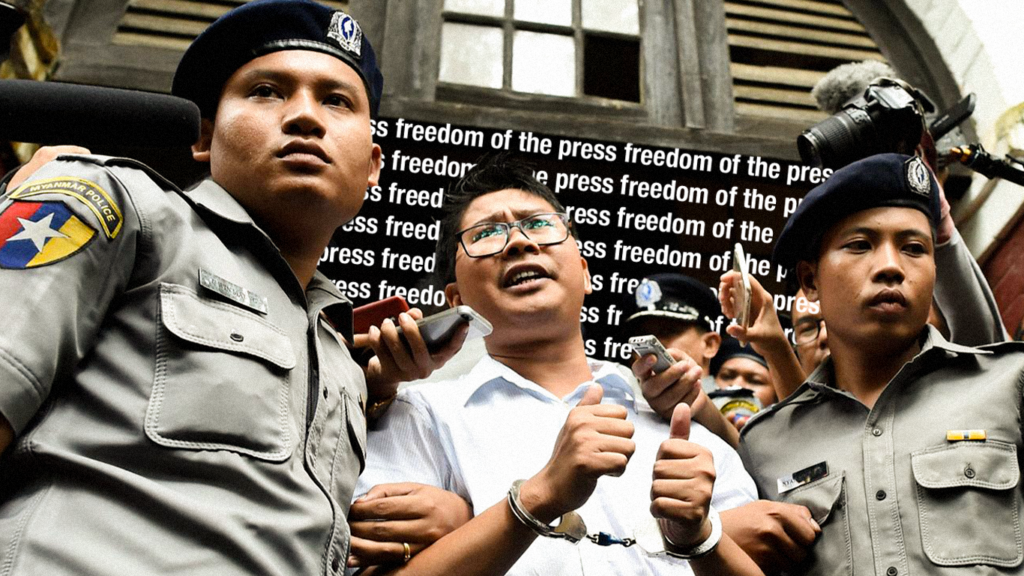
After a decade of relative democracy, a coup d’etat on February 1, 2021 plunged Myanmar back into unrest. These conditions have affected every citizen, but in the face of overt threats like military raids, sophisticated surveillance, air strikes, and internet shutdowns, journalists covering the country also contend with difficult-to-reach and traumatized sources, complex regional conflicts, a highly restricted information ecosystem, and a lack of funding.
The solutions these Burmese media organizations employ are as complex as the situations they report on: operating from abroad, decentralized information sharing, clandestine reporting techniques, and an army of highly trained citizen journalists.
This style of reporting “has been fostered in the country for the last 20, 25 years,” says University of Toronto professor Matthew Walton, whose research centres on religion and politics in Southeast Asia, with a special emphasis on Myanmar.
However, in the face of dwindling funding, this style of reporting may be endangered.
As of February 2026, data from an armed conflict location and event data tracker shows nearly 93,000 fatalities since the junta took control, with the United Nations estimating over 30,000 people have been arrested on political grounds.
The International Center for Not-For-Profit Law reports at least 226 journalists have been arrested since the 2021 coup, with around one quarter of them having been given extreme sentences of up to 27 years in prison. According to The Committee to Protect Journalists, seven journalists have been killed since February 2021.
Sai Kham Phu, CEO of the Shan Herald Agency for News (SHAN), recalls covering the protests in Taunggyi, the capital of Shan state, when the junta first seized control.
“Our journalists [were] hiding in the building, shooting videos and recording, [witnessing] the shooting of the people…our journalists had to hike to a safe place,” Phu says.
While the 2010s saw a period of relative press freedom, according to Reporters Without Borders, the press in Myanmar was “set back ten years in ten days” after 2021. Since then, Phu says the government’s goal has been “to silence the people’s voice.”
Surveillance mechanisms have helped the junta to stifle public dissent. According to Aung Zaw, the founder and editor in chief of Irrawaddy, an independent Burmese media outlet, the military government actively monitors outspoken journalists online.
“The junta surveillance techniques are more sophisticated than ever due to assistance from Beijing and Moscow,” he says.
On April 2, 2026, following what the United Nations (UN) referred to as a “sham election process” that populated Myanmar’s parliament with junta loyalists, General Min Aung Hlaing was elected president. But this false democracy, which the BBC called “more of a coronation than an election,” is something Burmese journalists are rallying against.
Soe Myint, the founder of Mizzima, a Burmese multimedia news organization with millions of followers across its social media, states bluntly, “right now, the military is again consolidating its power, and they will try to hoodwink the international community…Canadian people should know very well. There’s nothing changing. This doesn’t lead to any democracy or human rights or federal union or peace.”
For Myanmar’s journalists and media organizations, the fight to get information into and out of the country has never been more important.
Phu says SHAN was originally affiliated with the Mong Tai Army (MTA), an ethnically Shan armed group, but after the MTA surrendered to government forces in 1996, the news agency moved its operations to Thailand.
While briefly returning to Myanmar following democratic elections in 2010, after the coup in 2021, SHAN was forced to relocate once more.
SHAN is not the only media organization operating in exile. Myint cofounded Mizzima while in India in 1998. Banned by the junta following the coup, the outlet now covers Myanmar from abroad, operating out of India, Thailand, and the Czech Republic.
But being miles away presents a unique challenge for covering stories.
“[Citizen journalists] might be connected with newsrooms [outside Myanmar],” but media organizations don’t necessarily know “many details [about their location] for the sake of their security,” says Tin Zar Aung, the co-founder of non-profit Myanmar Women in Media (MWiM).
This makes fact-checking difficult too. Aung says one media organization may report on drone attacks, but the same one may also identify the wrong attack.
“This is challenging for the media organization, and also this is the impact for the reader,” she says.
Beyond hampering traditional newsgathering practices, this disconnect also endangers journalists and civilians. For instance, Phu says journalists who report unfavourably on the junta are often arrested, and the junta will only release them if they take down the news story.
“We cannot protect them, right? So that safety is our first priority, so that we compromise, remove the story from…social media, sometimes even [our] website, just for the safety of our [citizen journalist],” he explains. “Just reporting is not a crime, but the state treats journalists as criminals; that is not fair.”
Sources are treated similarly by the military government and other armed factions.
“They don’t feel secure if they provide information sometimes…people would like to speak up, they would like to provide information, but later on…[a group] would come and intimidate the source,” he adds.
Additionally, Aung says, “[Sources] are traumatized because of these kinds of problems…sometimes, [journalists] don’t know they are traumatized people.”
In 2023, along with two other women journalists, Aung co-founded MWiM to shine a light on the specific challenges women journalists face, such as exploitation and sexual harassment.
“We are concerned about [journalists’] safety, and our women journalists are facing a lot of the problem,” Aung adds.
Meanwhile, reporting on regions not controlled by the junta is dangerous too.
“Pieces that are critical of ethnic armed organizations or of the National Unity Government of Myanmar [the democratic government in exile] or things like that, those are not going to get you disappeared in the way that reporting in military-controlled areas might get you disappeared, but that’s going to maybe get more online backlash or that kind of backlash,” Walton says.
Most recently, as many government aid agencies, such as USAID and Global Affairs Canada, scaled back their funding, Burmese media organizations are feeling the pinch.
“The funding crisis is not only from the U.S., but also from others…most of the Myanmar media, independent media, rely on the funding,” explains Aung, who lost her job due to these funding cuts.
Against these odds, Burmese journalists have adapted.
While much reporting is done clandestinely in areas under government control, Mizzima’s reporters have adopted pseudonyms to collect information in the field. They also utilize VPNs, which are banned in Myanmar, and send their reports via end-to-end encrypted messaging services such as Signal.
In junta-controlled regions, Phu adds, the military has set up security checkpoints and will search people’s mobile devices. Even if the device is dead, he says they will use special equipment to extract the information.
“Myanmar journalists, they cannot use their cameras properly, they only can use their mobile phones…there are less journalists in the military region area. Some journalists are still working, but they are doing it undercover,” explains Aung.
Phu notes these reporters must wipe any sensitive photos and information from their phones. Once this information is collected, these media organizations have designed a unique system for sharing it.
“Working is decentralized based on security…but the same content, the same decisions, can be made instantly, so that is centralized,” Myint says. In practice, this means that information is gathered, fact-checked, and shared simultaneously.
Mizzima relies on various media formats including television and radio to get its message out. Its YouTube channel has millions of subscribers, it broadcasts newscasts in the middle of the night, and uses old-school FM radio transmissions to skirt social media and internet blackouts.
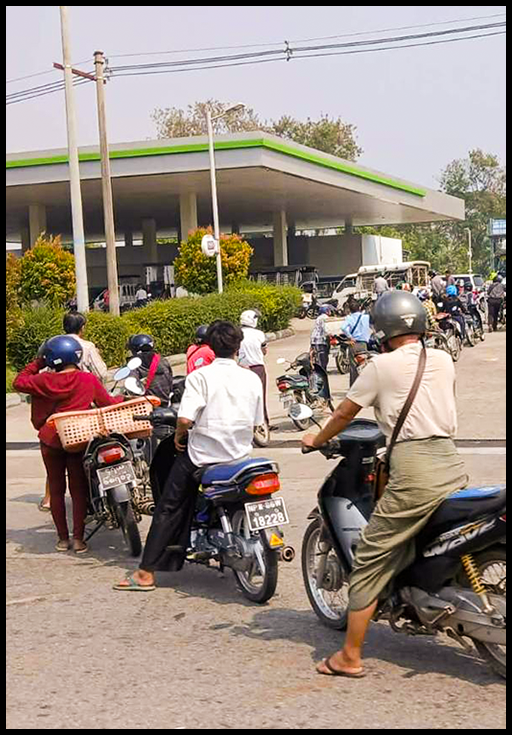
“Our reporters and [citizen journalists] are on the ground, particularly in severe fighting zones…our journalists strive to gather firsthand experiences and coordinate with the editorial team to produce accurate reports,” Zaw says of Irawaddy’s newsgathering process.
SHAN has similarly shifted to a digital newsroom. Yet junta-imposed internet blackouts, VPN bans, and high data costs are impeding their communication channels and information sharing.
“When [journalists] produce the news content or send the raw videos…[because of] heavy data, it’s difficult to send here to Chiang Mai,” Phu explains.
Meanwhile, an additional issue facing these digital newsrooms is cyber attacks.
“Our site has been under cyberattacks, 98 percent of the public access to our website was denied due to the attack during the election in Myanmar in December and January,” writes Zaw. Their only solution is to report the attacks to their partners and audience.
Burmese media organizations are also implementing sophisticated training systems. For example, Mizzima does not take volunteers because of how dangerous its operation is. Instead, they train their reporters for years, and have already trained roughly 200 to 300 journalists, according to Myint.
“It is not just news and information, a lot of work is parallel, including training, capacity building. Because a country like Myanmar really needs a long-term approach, it really needs a strategic approach. It is not just 10 years work, it is really life-long work,” says Myint.
Aung adds, “Sometimes we call [it] human rights reporting…citizen journalists need to know about the ethics, and also the journalist ethics…they try and share storytelling, conflict sensitivity, tactics…we are thinking, this is our duties and responsibility to share with the [younger] generation.”
SHAN also provides a list of secure contacts and safety protocols to citizen journalists. “[They] have to get the approval or green light from the editors…if they face threats, who to contact and that kind of thing,” he says.
Phu says that SHAN now benefits from its diverse network of sources.
“Our network includes different backgrounds and occupations: village leaders, monks, business, and teachers, business people, restaurant owners,” he says.
This kind of connection is also integral to the fact-checking process. In addition to open-source intelligence tools like satellite imagery, mapping software, and Google Images, Zaw says Irrawaddy checks all information — including scoops and publicly available details — against “trusted friends, official spokespersons, local residents, and citizen journalists.”
And despite everything, Phu says resilience continues in the communities SHAN serves, especially among young people.
“I don’t think the young people will give up in Myanmar…they are fighting…they will fight to get peace in the country,” he says.
This vision of a better future underscores his work. Regardless, Myanmar’s junta is still consolidating its power.
And while the international community has decried the situation — with the UN gingerly describing it as “less than conducive to advancing human rights” — those with the duty to report in the country say more needs to be done.
“I think we need international communities, or the industry to pay attention…. If there is a protection mechanism, that would be a better place, a better environment for the journalists in Myanmar,” Phu says, while Zaw argues international visibility is one of the most effective forms of security. “When a journalist’s name is known globally, it often (though not always) acts as a deterrent against the most extreme forms of extrajudicial violence,” writes Zaw.
In the meantime, Aung says Burmese journalists have no choice but to hold onto hope.
“We stay, keep going. We stay, we’re fighting. We’re fighting for our democracy back because the militaries control the country…so that’s why we are working for our people’s right to information.”

