
They inform awareness and change, identify vulnerable communities to report on, and create innovative methods of reaching new audiences.
In 2025, Canada experienced multiple catastrophic events as a result of climate change. It was one of the hottest years recorded, with heat waves creating the deadliest extreme weather event of the year. Wildfires and heatwaves broke out across the country. At CBC, The Narwhal, Global News, and other newsrooms, articles featured photos of blazing fires engulfing forests and skies filled with dark grey smoke. Indigenous communities were disproportionately affected and evacuated from their communities, accounting for 42 percent of Canada’s wildfire evacuations.
Our lands and the people who inhabit them face the repercussions of human failings which induce climate change events, and disproportionately, those who contribute the least, in terms of emissions and extraction, are affected the most. Newsrooms across the country, both large and small, covered these events throughout the year.
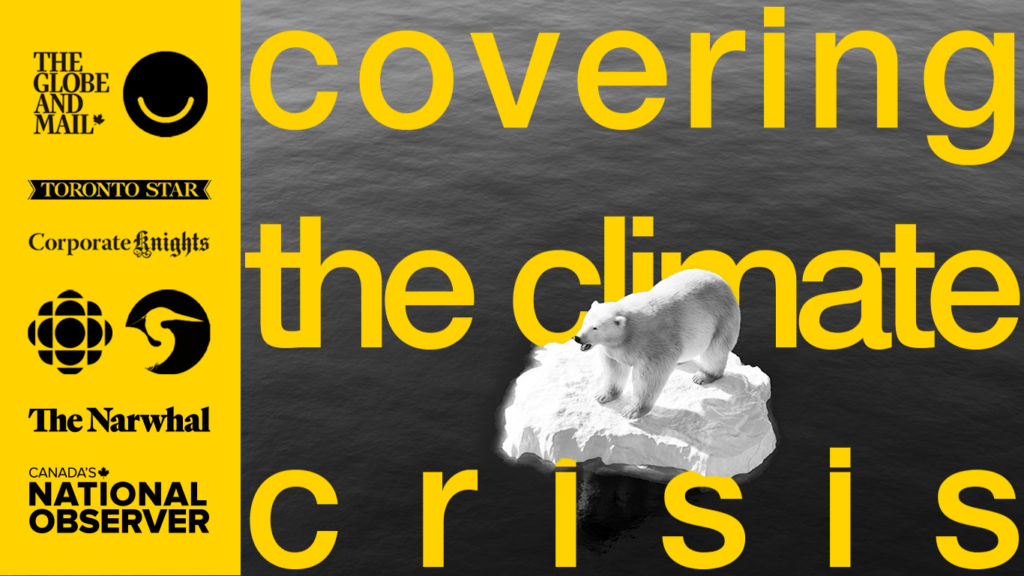
Still, the bulk of this responsibility seemed to fall on the mastheads of smaller, independent publications. Despite their prevalence on newsstands and online spaces, major publications like The Globe and Mail and the Toronto Star don’t dedicate as much of their coverage to climate change or the environment as alternative news publications. Even though they frequently report on environmental issues, it’s not common for these mainstream newsrooms to allocate consistent coverage to climate change compared to publications centring on marginalized viewpoints, specialized topics, and which exist outside of the traditional commercial news-sphere.
Carleton University–based Re.Climate, Canada’s leading space for climate change, energy, and sustainability research, found an “observable gap” in national news around coverage of climate policies. They looked specifically at coverage of the EV mandate, the Two Billion Trees program, and the Canada Greener Homes Grant. They say limited funding of newsrooms is a problem both major news outlets and alternative news outlets are facing.
It’s difficult to understand how Canada’s media landscape allocates its time and resources toward environmental news coverage because of the variations in funding across newsrooms. But it appears as though alternative newsrooms have more influence in the climate conversations we have and create as journalists, since this is their primary focus.
The state of environmental reporting in journalism is not represented by the amount of coverage major newsrooms allocate; alternative newsrooms are setting the precedent.
One example is the Narwhal, a nonprofit newsroom launched in 2018. It has national reach, with investigative journalists in British Columbia, the Prairies, and Ontario. The publication focuses strictly on issues of the natural world, reporting on stories “big news outlets miss”. Its journalism is often cited in articles at the CBC, the Globe, and the Star.
There is also Canada’s National Observer, another nonprofit founded in 2015. Its managing editor, David McKie, describes it as a “national digital publication based in Vancouver that concentrates on climate and Indigenous issues”. Part of its work is an initiative in partnership with the Institute for Sustainability, Education, and Action which publishes “solutions focused journalism” centring “on how Canadians are responding to the climate crisis.”
Other publications include Climate Stories Atlantic in the Maritimes, Corporate Knights in Ontario, and Watershed Sentinel and Happy Eco News in British Columbia.
“I guess I see climate and environmental journalism not just as a niche type of journalism, but as a beacon, or a flag, if you will, of the state of democracy,” says Carl Meyer, a reporter at the Narwhal.
As an environmental journalist, Meyer’s work covers topics of human impact from a political and community-centric perspective. He focuses on investigating the fossil fuel industry’s influence on climate policy and lobbying, Ontario Bureau development laws, the environmental impact of development, and the effect of things like mining on Indigenous communities.
Coupled with the awareness that the public cares about the environment, he tells the Review of Journalism how all the scientific proof around climate change should influence the government to act on the concerns of the masses. But action isn’t often taken, and in Canada, this can’t be justified by insufficient education or actionable suggestions.
In 2024, the federal government set a target to reduce planet-warming emissions by 45–50 percent despite being advised by the Net Zero Advisory Board to aim for a 50–55 percent reduction. The board made note that “targets below 50 percent will put Canada behind on its legislated objective of net-zero emissions by mid-century.”
As one of the most prominent environmental journalism publications in Canada, the Narwhal had over 4.6 million readers in 2025 and over 2.6 million unique site visits. “I see my function as putting things on the public record so that people can make the choices that they need to make,” says Meyer.
Action towards systemic changes and public policy initiatives requires awareness and education on present issues. In a lot of environmental coverage these days, researchers are seeing “solutions journalism.” The phrase refers to journalism that “present[s] behaviours, actions, and strategies that can mitigate, reverse, or help us adapt to environmental damage.”
Chris Hatch, the journalist behind the Observer’s newsletter “Zero Carbon,” says the “cruelest” part about climate change is the “injustice” of it, because the people who do the least to cause it suffer the most, like Indigenous communities.
Does this perspective make environmental journalism a duty of public service? It’s a question of society’s ability to survive. It’s about the intersection of democratic processes, human rights, and the acknowledgement of the consequences of our collective actions. Without journalists focusing on environmental issues, navigating efforts to revive what has been lost and damaged in the natural world would be ill-informed and consequently insurmountable.
For Hatch, part of the work is providing the context to environmental issues that he feels is lacking in other newsrooms, like what and who are causing the problem, and elevating the voices of people who are impacted by climate change.
“There’s not nearly as much coverage as the problem warrants. And then when there is, it’s one-off stories that don’t really situate the public in terms of where we’re at,” he says.
Hatch explains that environmental news coverage at major news outlets is “spotty and superficial” because the journalism industry is struggling to survive. He mentions how many journalists have lost their jobs and how newsrooms weigh the decision of whether to publish deep dives over current events.
Still, there is success in these alternative news spaces, where reporters dedicate their work to bringing awareness to environmental issues and advocating for change and accountability. Despite having less resources and readership, these publications are seeing that their work leaves an impact, both on individuals and on the way mainstream publications report on these issues.
Impact metrics tell Arik Ligeti, Director of Audience at the Narwhal, what’s being impressed upon readers. His findings show that 87 percent of respondents said they would feel like they’ve lost a source of news that they can’t find anywhere else if the Narwhal stopped publishing. Additionally, 30 percent of surveyed readers said they took action on environmental issues as a result of knowledge or perspective gained.
“The level of depth [at the Narwhal] whether that’s deeper dives, explainers, or on-the-ground reporting or long term investigations — just the amount of time that we dedicate to reporting our issues deeply — is something that we hear often [for being] the reason people come back to us and want to become a member,” Ligeti says.
David McKie, managing editor of the Observer, says gaps in this topic of reporting ultimately exist because governments, especially in the United States, are not focusing on climate in their policies and mandates. He alludes to President Trump’s lack of funding and cutting initiatives for climate change efforts.
“Climate is very much an issue, but it’s tied up with everything else,” he says.
This is why reporting at the Observer frames stories around climate change under the backdrop of topical issues like affordability. The reason for this is to retain and gain subscribers, driven by a will to “expand the conversation to attract people who think about climate, but maybe in a different way,” says McKie.
By making information about climate change more palatable and accessible to people who may not otherwise read about it, this is a valuable way to address the gaps in environmental reporting, he adds. He explains that the gaps that exist aren’t a lack of reporting, but they are gaps in audiences who aren’t being reached due to the way issues that directly and indirectly affect climate are covered.
Regardless of where they work, environmental journalists like Meyer, Ligeti, Hatch, and McKie play a critical role in emboldening people’s agency around combating climate change. Their roles are weighted with the responsibilities to inform, educate, and inspire change in a world in desperate need of revival.
About the author
